


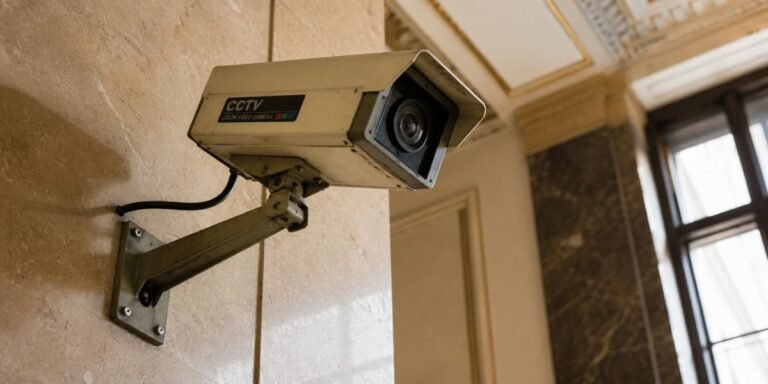
Long before banks filled their ceilings with discreet IP cameras and AI-assisted surveillance systems, security relied on a device that was impossible to miss: the old-fashioned bank security camera. The keyword what are those old fashion bank security cameras called usually refers to a handful of distinct camera designs that dominated financial institutions from the 1950s through the 1990s. Most commonly, people are thinking of dome cameras, pan-tilt-zoom (PTZ) cameras, or the highly visible box-style CCTV cameras that became symbols of institutional security.
What makes these cameras interesting isn’t nostalgia. It’s the fact that many of the design cues still shape modern surveillance hardware. The visible camera wasn’t merely recording crime; it was performing security in public.
Style Snapshot
- Common names: Box CCTV cameras, PTZ cameras, dome surveillance cameras
- Peak usage: 1960s–1990s
- Primary location: Banks, government buildings, retail stores
- Recording method: Analog closed-circuit television (CCTV)
- Storage medium: Magnetic videotape and later VHS-based systems
- Typical housing: Metal enclosure with large visible lens
- Key function: Crime deterrence as much as evidence collection
- Cultural significance: Became a visual shorthand for security and surveillance
The Camera Most People Remember Was the Box-Style CCTV Unit
When people picture an old bank security camera, they usually imagine a rectangular metal housing mounted high on a wall with a conspicuous lens pointed toward customers. These were known as box CCTV cameras.
The design was intentionally visible. Banks wanted customers and potential criminals to know they were being watched. Unlike today’s miniature cameras, concealment was not the goal.
I remember speaking with a security consultant during a bank renovation project in the late 2000s who pointed out that older surveillance systems often depended as much on psychology as technology. A camera that everyone could see created hesitation before a crime even occurred.
The cameras transmitted footage through a closed-circuit television (CCTV) network to monitors and recording equipment located in secure rooms. Because the signal remained within the bank’s private network, it was considered more secure than broadcast systems.
The Dome Camera Changed How Surveillance Was Perceived
By the 1980s and 1990s, many banks began replacing exposed box cameras with dome cameras.
The smoked acrylic dome made it difficult to determine exactly where the lens was pointing. This uncertainty created a strategic advantage. Anyone entering the building had to assume they were being watched at all times.
What often goes unnoticed is how influential this design became. The dome transformed surveillance from an obvious piece of equipment into an architectural element. Instead of hanging visibly from walls, cameras became integrated into ceilings and interior design.
That shift mirrored a broader trend in security philosophy: surveillance became continuous rather than merely performative.
PTZ Cameras Were the High-Tech Option of Their Era
In larger banks, especially headquarters and high-traffic branches, Pan-Tilt-Zoom (PTZ) cameras represented the premium tier of surveillance.
Unlike fixed cameras, PTZ units could rotate horizontally, tilt vertically, and zoom in on specific subjects. Security operators controlled them remotely from monitoring stations.
The technology seems ordinary today, but decades ago it was a major advancement. A single operator could follow suspicious activity across a lobby without needing multiple cameras.
One pattern that becomes obvious when studying older security installations is that banks rarely relied on PTZ cameras alone. They were usually paired with fixed cameras that continuously recorded key areas such as teller stations, entrances, and vault corridors.
What Made These Cameras So Effective Was Visibility
Modern surveillance focuses heavily on image quality, analytics, and data storage. Older bank cameras pursued a different objective: deterrence.
The large housings, prominent mounting positions, and obvious lenses communicated authority. They reminded everyone entering the building that their actions were being documented.
That philosophy explains why vintage security cameras remain recognizable decades later. Their appearance became part of the security system itself.
Even today, some businesses intentionally install visible cameras alongside hidden systems because the deterrent effect remains valuable.
Why These Cameras Still Matter
When people search what are those old fashion bank security cameras called, the answer is usually box-style CCTV cameras, though some may be referring to dome cameras or PTZ surveillance cameras depending on the era they remember.
The interesting part isn’t the name. It’s how these devices shaped public expectations of security. Modern surveillance technology may be smaller, smarter, and far more capable, but it still relies on principles established by those unmistakable old bank cameras: visibility, deterrence, and the constant suggestion that someone might be watching.
Read More: High-Resolution Surveillance: The Power of 4K Security Camera
