


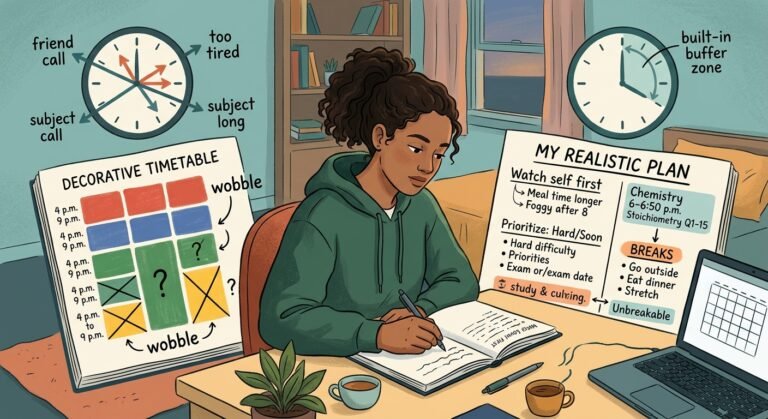
I want to start with something that’s probably already happened to you. You sit down, usually the night before a new term starts or right after a teacher mentions an upcoming exam, and you make a study timetable. A proper one. Color-coded, maybe. Every hour from 4 p.m. to 9 p.m. accounted for, subject by subject, down to the half hour.
For two days it’s great. You feel organized for possibly the first time all semester. And then something small happens.you’re more tired than expected, or a friend calls, or one subject just takes way longer than the fifty minutes you gave it and the whole structure wobbles. By the weekend it’s basically decorative. You still open the notebook sometimes, look at it, feel a little guilty, and go back to studying whatever feels urgent that day.
If that sounds familiar, it’s not because you’re bad at sticking to plans. It’s because the plan itself was built wrong. Most study timetables are designed for a version of the week that doesn’t exist — one with no bad days, no interruptions, and identical energy at 6 a.m. and 9 p.m. Once you stop building for that imaginary week and start building for the one you actually have, the whole thing gets a lot easier to stick to.
Here’s how I’d go about it.
Start by watching yourself for a few days, not planning yet
This step gets skipped constantly, which is a shame because it’s the one that makes everything after it work. Before you write a single time block, spend three or four days just noticing what you actually do with your hours. Not what you plan to do — what you do. When do classes end? How long does the commute really take, door to door? What time do you actually start feeling foggy in the evening?
Most people who do this are a little surprised by the results. Free time turns out to be smaller than it feels in your head, because things like meals, transport, and general downtime quietly eat more of the day than you’d guess. And there’s usually a window — often right after a big meal, or late at night after a long day — where you technically could study but realistically won’t focus on much of anything. Better to know that now than to keep scheduling your hardest subject into it and wondering why it never sticks.
Figure out what actually deserves your time this week
Once you know your real hours, the next question is what goes in them. And here’s where a lot of students, without really meaning to, sabotage themselves: they gravitate toward the subjects they like. Which makes sense — nobody wants to spend an hour on the subject that makes them feel stupid. But it means the subject you’re actually struggling with, the one with a test coming up in four days, keeps getting pushed to “later,” and later arrives faster than expected.
A more useful way to decide is to weigh two things against each other: how hard something currently is for you, and how soon it’ll be tested. Something that’s both hard and close on the calendar wins this week, full stop, even if it’s the least fun thing on your list. Something easy that’s weeks away can get a light touch — just enough contact to keep it from going stale, not enough to steal time from what’s actually urgent.
Make your blocks specific enough that you know when you’re done
This is probably the single biggest difference between a timetable that works and one that doesn’t. “Study chemistry, 6 to 7” sounds fine written down, but it’s actually a pretty demoralizing thing to sit down to, because there’s no finish line. Are you done at 6:30 if you feel like it? Is 7 o’clock the real end, no matter where you are in the material? Nobody knows, including you, and that vagueness is exactly the kind of thing that makes a task easy to put off.
Compare that to something like: chemistry, 6 to 6:50, finish the stoichiometry problem set, questions 1 through 15. That’s a task with an actual edge to it. You can picture finishing it, which — oddly enough — makes it easier to start it.
On length: something in the 40-to-50-minute range tends to work for a lot of people before focus starts sliding, but this really does vary person to person. If you know you can go longer, go longer. If 25 minutes is your honest ceiling, plan around that instead of some number you read somewhere. The point isn’t the specific number, it’s matching the block to how your attention actually behaves.
Don’t treat breaks like the thing you cut when you’re behind
This one’s worth saying plainly because almost everyone does it wrong: breaks get treated as optional, the first casualty when the schedule slips. That’s backwards. A break isn’t time stolen from studying — it’s part of how what you just studied actually sticks. Three hours straight of reading doesn’t give you three hours of learning. It usually gives you something closer to ninety honest minutes, stretched out with ninety more minutes of your eyes moving over a page while your brain has quietly left the building.
A rhythm that works reasonably well: five or ten minutes after each block, just to stand up and reset, then something closer to half an hour to an hour after two or three blocks, long enough to actually eat or get outside for a bit. The reason to write these into the schedule rather than letting them happen naturally is that an unplanned break has no edges — twenty minutes on your phone turns into an hour with almost no warning. A scheduled break, with a clear end time, is much easier to actually come back from.
Build in room for the week to go wrong, because it will
Nobody executes a perfect week. Something always throws it off — an extra assignment nobody warned you about, a rough night’s sleep, just one of those days where motivation doesn’t show up. The students who keep a timetable going for months, not just a few days, aren’t the ones who never have a bad day. They’re the ones who left space for one.
In practice that might mean one genuinely open hour somewhere in the week with nothing scheduled, purely there to absorb whatever fell behind. Or it might just mean planning slightly under your real capacity each day, so if something runs long there’s room to let it without the rest of the evening falling apart. Either way, the goal is a schedule that expects to get knocked off course a little and can absorb that without collapsing entirely — not one that assumes everything goes perfectly and shatters the first time it doesn’t.
Actually look back at it once a week
A timetable isn’t something you write once in September and follow unchanged through June. Workloads shift. Exams come and go. Some subject you thought would need light attention turns out to need way more. Give yourself ten minutes at the end of each week — Sunday night, or whenever you naturally reset — and be honest about what actually happened. Which blocks did you really do? Which ones got skipped every single time, and why? Is there a subject that’s been quietly sitting on the schedule without ever getting the attention it needs?
Whatever you find should change next week’s version. Do this for a month and you end up with something that genuinely fits how you work, rather than a template you copied off a website (including, arguably, this one).
One version, just so it’s not abstract
| Time | Activity |
|---|---|
| 6:30–7:00 a.m. | Wake up, glance back over yesterday’s notes |
| 7:00–8:00 a.m. | Get ready, eat, commute |
| 8:00 a.m.–3:00 p.m. | School |
| 3:00–4:00 p.m. | Lunch, actual downtime |
| 4:00–4:50 p.m. | Hardest subject, while there’s still energy for it |
| 4:50–5:00 p.m. | Short break |
| 5:00–5:50 p.m. | Second subject |
| 5:50–6:30 p.m. | Longer break, dinner |
| 6:30–7:20 p.m. | Third subject |
| 7:20–7:30 p.m. | Short break |
| 7:30–8:00 p.m. | Light review, nothing new |
| 8:00 p.m. on | Free |
Don’t copy this exactly — it’s just meant to show the shape. Someone who studies better at night should probably flip the whole thing around. Someone working a part-time job after school needs a completely different structure. What matters is the underlying logic, not the specific hours.
What the whole thing is really for
It’s tempting to think of a timetable as a discipline tool — something that forces you to work harder. I don’t think that’s quite it. What it actually does is get rid of a small, exhausting decision you’d otherwise make dozens of times a week: what should I even be doing right now? That question, asked over and over, burns more energy than people give it credit for — energy that should be going into the work itself, not into deciding what the work is.
A timetable that’s honest about your real hours, specific about what “done” looks like, and loose enough to survive a bad Tuesday will beat a beautiful, color-coded, unrealistic one every time. It doesn’t need to be impressive. It just needs to still be in use three weeks from now.
Happy to trim this down, shift the tone (more casual for a student blog, more formal for a school site), or turn it into a Word doc or Markdown file if you want a downloadable version.
