


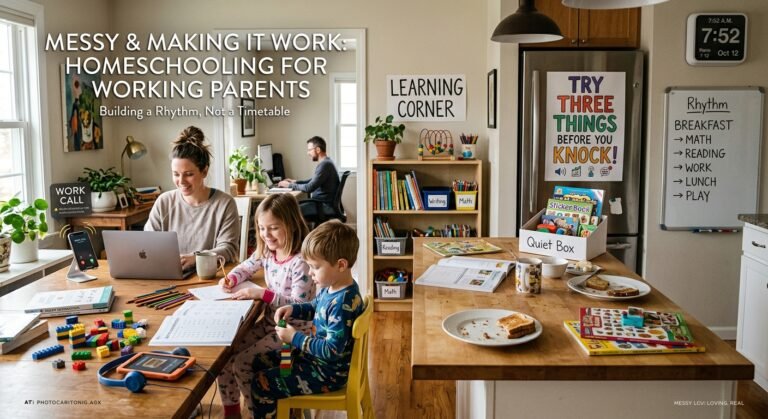
It’s 7:52 a.m. One kid is crying because the toast broke. Another is asking what 7 times 8 is, for the third time this week. Your phone buzzes. It’s work. Somebody needs “a quick sync,” which has never once been quick.
And you’re thinking: how on earth do people do this?
Honestly? Messily. Nobody in the homeschool world has it all together, no matter how pretty their Instagram looks. The parents who make it work while holding down a job aren’t superhuman. They’ve just stopped trying to copy what school does and started building something that fits their own house, their own kids, and their own chaos.
So that’s what this article is about. Ten tips about Homeschooling Tips for Working Parents, nothing fancy. Some are practical, a few are about your head more than your calendar, and one or two are just small tricks that might save you a bad Tuesday. Grab what helps. Skip what doesn’t. Nobody’s grading you.
1. Stop trying to recreate a classroom
Close your eyes and picture “school.” Rows of desks, a bell, a teacher up front, six hours of lessons.
Now forget it.
That setup exists because one adult has to manage twenty-five kids at once. You’ve got one or two or four. When you teach a child one on one, things move fast. Really fast. A lot of families get through the core stuff in two or three hours a day, because there’s no waiting for the whole room to catch up, no lining up for the bathroom, no attendance, no hallway chaos.
So if your “school day” is an hour and a half of real work before you open your laptop, some reading while you’re on calls, and a quick review after dinner, congratulations. That’s a school day. It counts.
This one shift took a weight off so many working parents I know. You can’t feel behind on a schedule you never needed in the first place.
2. Go for a rhythm, not a timetable
I know you want to make a gorgeous color-coded schedule. I did that once, years back, on a different project, and it lasted about nine days. Then a kid got a fever, the schedule collapsed, and I felt like a failure over a spreadsheet. A spreadsheet!
What works better is a rhythm. Same order every day, loose clock. Breakfast, then math with you, then reading, then you jump on work while the kids do their own thing. Lunch. Outside. Projects. Done.
If a meeting runs long, the day slides. No panic, because nothing was pinned to a minute.
Kids like this too. They don’t need to know it’s 10:15. They just like knowing what’s coming next.
Here’s a sample for a parent working from home:
| Part of the day | What the kids do | What you do |
|---|---|---|
| Early morning | Breakfast, chores, free play | Coffee. Maybe some quiet work. |
| Mid-morning | Math and writing with you | Teach for about 90 minutes, then log on |
| Late morning | Reading, workbooks, audiobooks | Calls and focused work |
| Lunch | Eat, then run around outside | Eat a real lunch (try it) |
| Early afternoon | Art, science, projects, quiet play | More work, with one check-in halfway |
| Late afternoon | Sports, library, co-op, errands | Wrap up work, switch to parent mode |
| Evening | Family time, a read-aloud | Plan tomorrow in ten minutes, then stop |
No times. On purpose.
3. Pay attention to when everyone’s brain actually works
Some people wake up bright and cheerful at 6 a.m. I am not one of them, and chances are one of your kids isn’t either.
Spend a week just watching. Who’s sharp in the morning? Who falls apart at 3 p.m.? When do the arguments start? Then put the hard stuff, like math and writing, in the good hours, and save the gentle things for the slump. Read-alouds. Drawing. A documentary. Audiobooks while they build Lego.
Same goes for you. If your job gives you any wiggle room, move your toughest work to when the kids are busiest or most independent. Lots of working homeschool parents get up an hour early, or work after bedtime, or split the day into two shifts. There’s no gold-star answer here. The right one is whichever doesn’t leave you hiding in the pantry eating chocolate chips out of the bag.
4. Teach them to do things without you
This is the big one. If you only fix one thing, fix this.
Every little skill your kid picks up is time handed back to you. Plus it makes them more capable, which is kind of the whole point of education anyway.
You don’t have to wait until they’re teenagers. Little kids can do more than we think:
| Age | What they can handle on their own |
|---|---|
| 5 to 6 | Follow a picture checklist, pick a book, do a page of handwriting, put things away |
| 7 to 9 | Read instructions, check answers against a key, work alone for 20 to 30 minutes |
| 10 to 12 | Plan a week with you on Sunday, use a timer, keep track of their own work |
| 13 and up | Run a whole subject, take online courses, ask for help only when truly stuck |
It’s slow at first. You’ll want to just do it yourself because it’s faster, and that urge is real. Fight it. A few weeks of patience now buys you months of peace.
Teach them what to do when they’re stuck, too. Try it again. Reread the instructions. Ask a sibling. Then ask you. A hand-lettered sign on the fridge that says “Try three things before you knock” has saved more than one important call.
5. Buy the curriculum you’ll actually use
I’ve watched this happen so many times. A parent falls in love with some gorgeous, thick, teacher-heavy program with hands-on activities for every lesson. It arrives. It looks amazing. Prep takes two hours a day. By October it’s a very expensive doorstop.
Be honest with yourself about how much time and energy you really have. Not the version of you in August who feels motivated. The version of you in February after a rough week.
| Style | Prep time | Good for | Watch out for |
|---|---|---|---|
| Open-and-go, fully scripted | Almost none | Parents who are short on time | Can feel rigid |
| Video or online courses | Low | Subjects you’d rather not teach | Too much screen time |
| Self-paced workbooks | Low | Independent, older kids | Still needs a quick daily check |
| Co-op or tutor classes | Low, but you drive | Art, labs, languages | Cost and scheduling |
| Build-it-yourself, book-based | High | Parents with flexible hours | Burnout, fast |
And switching isn’t failing. If something’s a slog after a few weeks, change it. Almost every long-time homeschooler has a closet full of abandoned materials, and they’ll tell you every bit of it taught them what their family actually needs.
6. Keep a small, firm core
This is my favorite way to simplify a week. Pick the few things that happen every single day, no matter what. For most families it’s reading, writing, and math.
That’s your core. Everything else, like science, history, art, music, geography, whatever, orbits around it.
When the day falls apart (and it will, probably by Wednesday), you protect the core and let the rest slide. Got math and reading done? Good. You won the day. Go eat something.
The extras don’t even need lesson plans half the time. Cook dinner together and boom, fractions. Walk around the block and count birds, then look up the ones you didn’t know. Watch a movie about space on Friday. Kids soak this stuff up when they’re curious, and curiosity is mostly free. You just have to say, “Huh. I wonder why that happens?” and then maybe not know the answer, and look it up together.
7. Give learning a little corner of your home
You don’t need a classroom. Please don’t convert your guest room unless you really want to.
But having one spot where schoolwork lives helps a lot. A kitchen table and a rolling cart. A corner of the living room with a basket of books and a jar of pencils. It just has to be easy. If it takes fifteen minutes to dig up the scissors and the right workbook, that’s fifteen minutes of your precious work window gone before anyone’s started.
Keep supplies where the kids can reach them. Label the bins. Do a two-minute tidy at the end of each day so you don’t face a disaster on Saturday.
You need a boundary for your own work, too. A closed door, headphones, a little “On a call” card hung on the doorknob. Little kids especially need something concrete. For them, I’d make a “quiet box” of special things that only come out during your work time: puzzles, sticker books, building sets, a new audiobook. When it’s rare, it stays exciting.
8. Ask for help (and keep asking)
Nobody can do this alone. Really, no one.
If there are two of you, sit down and talk honestly about who does what. Maybe one handles mornings, one handles afternoons. Maybe one teaches math and the other takes reading and science. It doesn’t have to be even. It just has to be something you both agreed on and can actually live with.
If you’re parenting solo, or your partner works long hours, your village matters even more. A grandparent who takes one afternoon a week. A neighbor with kids who’ll swap with you. A responsible teenager from down the street who’s good at math and wants to earn some money.
And look at local homeschool co-ops. Many meet once or twice a week, and other adults teach your kids art, science labs, or a language, while you work or finally sit down. It also gives your kids friends, which leads right into the thing everyone asks about.
9. Yes, they’ll have friends
“But what about socialization?” Every homeschooler hears it, usually from an uncle, usually at a holiday dinner, usually right as you’re passing the potatoes.
Here’s the truth. It’s easier than people think. Homeschooled kids often end up comfortable with all ages, because they spend time with adults, little kids, teens, whoever’s around, instead of only kids born in the same twelve months.
Sign up for a few things. A weekly sports team. A library program. Scouts. A music lesson. A park day. Two or three regular activities is usually plenty, and plenty of them happen on evenings and weekends anyway, which is perfect for a working parent.
Just don’t overdo it. It’s very easy to say yes to everything and end up living in your car. If your calendar makes you tense, cut something. A kid with a few good friends and lots of unhurried time is doing fine. Better than fine, really.
10. Look after yourself, too
I put this last, but it might be the most important one.
This is a marathon. If you sprint for the first month, you’ll crash by Christmas. So rest is part of the plan, not a reward for finishing it. Sleep when you can. Eat food that isn’t the crusts off a sandwich. Take a lighter week every couple of months and don’t apologize for it.
And check in with yourself now and then. Every season or so, ask: Is this working? Are the kids learning? Am I okay? If the answer is no, change something. Some years a family homeschools full time. Some years it’s part time. Some years the kids go back to school for a while. None of that is failure. That’s just family life, and family life changes.
Also, be kind on the bad days. There will be bad days. The day you ordered pizza, skipped science, and let everyone watch a movie so you could hit a deadline? They learned something that day too. They saw a real person with real responsibilities figure it out. That’s a good lesson to have.
All 10 tips on one page
| # | Tip | The short version |
|---|---|---|
| 1 | Skip the classroom model | Two to three focused hours is plenty |
| 2 | Build a rhythm | Same order, flexible clock |
| 3 | Follow your family’s energy | Hard stuff when everyone’s sharp |
| 4 | Teach independence | Every skill they learn buys you time |
| 5 | Choose realistic curriculum | Match your real bandwidth |
| 6 | Keep a small core | Protect reading, writing, math |
| 7 | Make a simple space | Less hunting for scissors |
| 8 | Ask for help | Swap, share, join a co-op |
| 9 | Keep socializing simple | Two or three regular activities |
| 10 | Take care of yourself | Rest is part of the plan |
One last thing
You don’t have to do this perfectly. I mean it. Kids are tougher than we give them credit for, and they learn more from being around an engaged, loving adult than from any flawless lesson plan.
So start small. Pick two or three of these ideas and try them for a couple of weeks. See what sticks. Tweak what doesn’t. That’s not a sign you’re doing it wrong. That’s the process.
You’re carrying a lot, and if you’re reading this at the end of a long day, you clearly care. That already counts for more than you think.
You’ve got this.
Frequently asked questions
Can you really homeschool and work full time?
Yes, plenty of families do. It usually takes flexible hours, a simple curriculum, shared duties between adults, and kids who learn to work on their own. Expect some trial and error along the way.
How many hours a day do you need to homeschool?
Usually far fewer than a regular school day. Many families finish core subjects in two to three hours, with more learning happening through reading, projects, and play. Rules vary by region, so check your local requirements.
What’s the best homeschool curriculum for busy parents?
Look for open-and-go, self-paced, or video-based programs that need very little prep. The best pick depends on your child’s age, how they learn, and how much teaching time you honestly have.
