


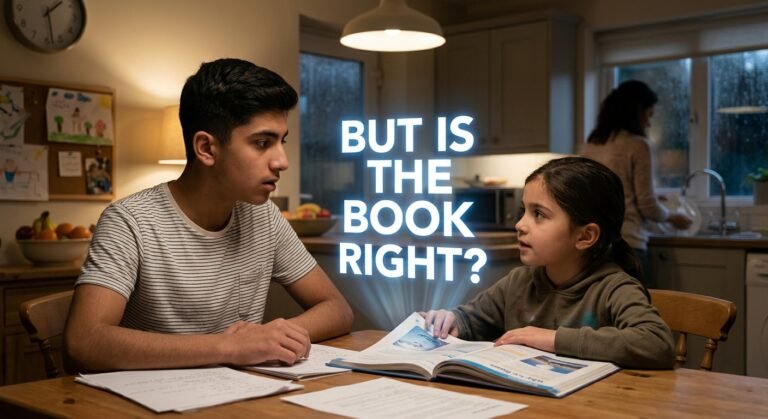
My cousin Hamza was the kind of student teachers adored. Neat handwriting, top marks, never late. One evening he was helping his little sister with a science question about why ice floats, and I heard him say, “Just write what’s in the book.” She asked him, quite reasonably, “But is the book right?” He didn’t know what to say. Nobody had ever asked him that either.
I think about that moment a lot, because it sums up a quiet problem in education. We produce students who can remember almost anything and question almost nothing. Then we wonder why they believe every viral post, copy the first search result, and freeze when a problem doesn’t look like the one from last week’s worksheet.
Here’s the encouraging part. Develop critical thinking skills in students are not something you’re born with or without. They’re built, the way a muscle is built, through small repeated efforts. This guide walks through what actually works, drawn from classroom practice and plain common sense, written for teachers, tutors and parents who want real change and not just a poster on the wall saying “THINK!”
So what is critical thinking, really?
Let’s strip the jargon away. Critical thinking means not swallowing things whole. It’s the habit of stopping to ask: Who is saying this? What are they basing it on? Could it be wrong? What am I not being told? And then making up your own mind based on the answers.
It doesn’t mean being rude or cynical. A critical thinker isn’t the person who rolls their eyes at everything. They’re the person who says, “Interesting, can you show me where that comes from?” and genuinely wants to know.
It also isn’t the same as having opinions. Everyone has opinions, usually strong ones. What separates a thoughtful person is that they can explain how they got there, and they’ll change course if someone shows them something better.
Most experts break the whole thing into a few core abilities:
| Ability | In plain words | What it sounds like in a student’s mouth |
|---|---|---|
| Analysing | Taking something apart to see how it works | “The article has two arguments, and only one has proof.” |
| Evaluating | Deciding how trustworthy or strong something is | “This site is selling the supplement, so I won’t rely on it.” |
| Inferring | Working out what’s likely from clues | “The soil is cracked and dry, so it probably hasn’t rained for weeks.” |
| Interpreting | Understanding meaning in context | “Fifty percent sounds huge, but it’s only two people out of four.” |
| Explaining | Showing your reasoning to others | “I picked this answer because of these two facts.” |
| Self-checking | Catching your own errors | “Hang on, I never actually checked that assumption.” |
You’ll notice none of these are advanced. A ten-year-old can do a basic version of every single one. That’s the whole point: you don’t wait until university to start.
Why students struggle with it
Honestly, most schools weren’t designed to teach this. Exams reward right answers, fast. Syllabuses are crammed. Teachers are exhausted. In that environment, “just give me the answer” is a perfectly logical strategy for a student, and we’ve trained them into it.
There’s also a handful of myths that keep adults from trying:
| The myth | The reality |
|---|---|
| “Clever kids already think critically.” | Cleverness helps, but plenty of brilliant people are great at defending nonsense. It needs practice. |
| “Teach the facts first, thinking can wait.” | The two grow together. People think better about things they know, and remember facts better when they use them. |
| “It needs its own special class.” | It works best folded into maths, science, history, English, everything. |
| “Questioning teachers is disrespectful.” | A polite “how do we know that?” is a sign of engagement, not rebellion. |
| “Little kids can’t do it.” | Five-year-olds guess, compare and test all day long. They just need age-sized tasks. |
Strategy 1: Change the questions you ask
If you only take one idea from this article, take this one. The questions you ask decide the kind of thinking that happens in your room.
“When did the war begin?” gets you a date. “Why do you think it was so hard to stop?” gets you reasoning. You need both, but if ninety percent of your questions are the first kind, that’s what you’ll get back.
Try swapping some of your everyday questions:
| Instead of… | Try… |
|---|---|
| What’s the answer? | How did you get there? |
| Is that correct? | What would prove it right or wrong? |
| What does the writer say? | What does the writer want us to believe? |
| Can anyone summarise this? | Which part of this would you push back on? |
| Is everyone clear? | What still doesn’t quite add up? |
| What happened? | What else could have happened, and why didn’t it? |
Don’t switch everything overnight. Pick one or two swaps and use them every day for a fortnight. They’ll start to feel natural, and so will the students’ answers.
Strategy 2: Wait. Longer than feels comfortable.
This one’s almost embarrassingly simple. After you ask a proper question, stay quiet for around seven seconds. Count in your head if you must.
It feels like an eternity. You’ll want to jump in, rephrase, or call on the confident kid in the front row. Don’t. Studies of classroom talk going back decades suggest that when teachers wait even a few extra seconds, students give longer, richer answers, and more of them take part. Thinking takes time. Silence isn’t failure, it’s the sound of it happening.
One more thing: ask “why do you think that?” about correct answers too. If you only ever probe wrong answers, students learn that follow-up questions mean “you messed up.” Ask it constantly and it just becomes how your classroom talks.
Strategy 3: Make reasons non-negotiable
A very useful habit is the Claim, Evidence, Reasoning routine. Whenever a student says something, ask for three things. What’s your claim? What’s your evidence? And how does the evidence actually support the claim?
That third part is where most students trip. They’ll say “the king was cruel,” quote a line from the text, and stop, as though the quote speaks for itself. Ask them to say the missing step. “Why does that line show cruelty?” It takes a bit of effort at first, and then something clicks, and their writing gets noticeably sharper.
Strategy 4: Teach them to check sources
Students today have more information than any generation before, and almost no training in sorting it. A simple checklist, repeated until it’s automatic, does wonders:
| Ask this | Because |
|---|---|
| Who made it? | Authors have expertise, or they don’t. They also have motives. |
| Why did they make it? | A news report, an advert and a joke all behave differently. |
| What proof is given? | A claim with no evidence is just a loud opinion. |
| Do other reliable places agree? | Real facts usually turn up in more than one independent spot. |
| How old is it? | Some information expires, especially in tech and health. |
| What’s missing? | The silence in a source can say as much as its words. |
Here’s an activity that never fails. Show students a slick, official-looking website that’s totally fake (there are several made for exactly this purpose) and let them find out for themselves. The little jolt of “wait, I nearly believed that” teaches more than ten warnings.
And yes, this includes AI tools. Teach students to treat any chatbot answer like a confident stranger on a train: worth listening to, worth double-checking.
Strategy 5: Show them the tricks
Every student should be able to smell a dodgy argument. You don’t need fancy Latin labels. You need kids who think, “hmm, that doesn’t follow.”
| The trick | What it sounds like | What’s wrong with it |
|---|---|---|
| Bandwagon | “Everybody’s got one, so it must be good.” | Popular isn’t the same as true. |
| Attacking the person | “Ignore him, he’s just a kid.” | It dodges the actual idea. |
| False choice | “Either we ban phones or nobody learns anything.” | There are usually more than two options. |
| Slippery slope | “Allow one late essay and soon no one will submit on time.” | It leaps to the worst case with no proof. |
| Small sample | “Two rude waiters there, so the whole city’s rude.” | Too little evidence for a big claim. |
| Emotional pull | A heartbreaking photo to sell an unrelated product | Feelings aren’t evidence. |
| Mixing up cause | “Ice cream sales and drownings both rise in summer.” | Things can happen together without one causing the other. |
Let students hunt for these in real life: adverts, headlines, videos, even things said at family gatherings (gently, please). Finding one themselves beats any worksheet.
Bias needs a mention too. Everyone has it. You do, I do, every newspaper does. The aim isn’t to find a perfectly neutral source, because those don’t exist. The aim is to notice the slant and factor it in.
Strategy 6: Let them argue (and lose)
Ideas get sharper when they bump into other ideas. So give students safe, structured ways to disagree.
Debate with assigned sides. Arguing a position you don’t hold is a brilliant way to understand why sensible people disagree. Swap sides halfway for extra bite.
Socratic circles. Students discuss a text or question together, with you mostly staying out of it. One rule: respond to the previous speaker before making your own point.
The steel man. Before criticising a view, state it so well that its supporters would nod. It’s the opposite of twisting someone’s words, and it builds fairness.
Think, pair, share. Think alone, talk to one partner, then share with the class. Shy students finally get a runway.
But all of this depends on one thing: students must feel safe being wrong. If a wrong answer brings humiliation, they’ll stop trying and just guess what you want. Try celebrating a useful mistake out loud: “Great wrong answer, because loads of people fall into that exact trap.” The atmosphere shifts faster than you’d expect.
Strategy 7: Give them real problems
Nobody gets excited about “identify the main idea.” Plenty of people get excited about “should our school day start an hour later?” because they have skin in the game.
Open-ended, messy, real-world questions make students research, weigh options, and defend a position. They don’t need tidy answers, and some shouldn’t have any. A few ideas:
| Subject | Problem to try | Skills it builds |
|---|---|---|
| Science | Which brand of tissue is actually strongest? Design a fair test. | Planning, controlling variables |
| Maths | Is the bigger pizza always the better deal? | Comparing, justifying |
| History | What mattered more: the printing press or the steam engine? | Weighing evidence |
| English | Can we trust this story’s narrator? | Inference, close reading |
| Civics | Should the voting age drop to 16? | Seeing other viewpoints |
| Daily life | Which phone plan is best for our family? | Using data, making choices |
Don’t be scared of problems with no clean ending. Life doesn’t come with an answer key, and students who’ve practised sitting with uncertainty cope far better with the real thing.
Strategy 8: Make thinking visible and reflect on it
You can’t improve something you can’t see, and thinking happens invisibly inside people’s heads. So drag it out. Ask students to draw a mind map, list pros and cons, write a short explanation, or finish the sentence “I used to think… but now I think…”
Then, after a task, spend three minutes on reflection:
- What was the trickiest part and how did I handle it?
- Did I change my mind at any point? What changed it?
- What did I assume without checking?
- What will I do differently next time?
Three minutes. That’s all. But this is where the learning gets locked in, and it’s how students become people who watch their own thinking.
Strategy 9: Match the method to the age
You wouldn’t teach a six-year-old and a sixteen-year-old the same way. The goal is constant; the tools shift.
| Age | Main focus | What works |
|---|---|---|
| 5–7 | Curiosity, comparing, “why?” | Sorting games, predicting then testing, “what if?” stories |
| 8–11 | Giving reasons, fact versus opinion | Fact-or-opinion sorts, simple experiments, mini debates |
| 12–14 | Judging sources, spotting bias | Comparing articles, persuasive writing with counterarguments |
| 15–18 | Complex reasoning, uncertainty | Seminars, research projects, reading data and statistics |
| University | Original argument, challenging experts | Case studies, critiques, peer review |
With little ones, keep it playful. “Is this the best sandwich in the world?” is a perfectly good lesson, as long as you follow it with “how could we find out?”
Strategy 10: Assess the thinking, not just the answer
Critical thinking doesn’t show up well on a multiple-choice test. So look at the quality of reasoning. Two students might reach the same conclusion while one has thought far harder than the other, and your marking should be able to tell the difference.
A simple rubric helps:
| Area | Beginning | Developing | Strong |
|---|---|---|---|
| Evidence | Mostly opinion | Some relevant evidence | Varied, reliable evidence, clearly explained |
| Reasoning | Jumps to conclusions | Mostly logical | Clear, connected, spots its own weak points |
| Other views | Ignored | Briefly mentioned | Treated fairly and answered |
| Questioning | Takes things as given | Asks a few useful questions | Asks questions that change the problem |
| Self-checking | Rarely notices errors | Spots some afterwards | Catches and fixes errors as it goes |
Hand out the rubric before the task, not after. And write comments, not just numbers. “Your second point is strong, but you never explained why that source is reliable” will teach more than a 7 out of 10 ever could.
Mistakes worth avoiding
Even good teachers and parents fall into these.
Rescuing too quickly. When a student is stuck, resist the urge to hand over the answer. Try “What have you tried so far?” first.
Treating it as a one-week topic. A short logic unit won’t survive a term of memorise-and-repeat. It has to be everywhere, a little at a time.
Praising only correct answers. If someone reasoned beautifully and still got it wrong, say so. That’s the behaviour you want more of.
Wanting them to agree with you. If students sense there’s a “right” opinion, they’ll perform it. Admit your own uncertainty. Let them disagree.
Banning technology. It doesn’t work. Teach students to question what they find online and what AI tells them instead.
A weekly routine you’ll actually stick to
Big overhauls fade by week three. Small routines survive. This one takes under forty minutes a week.
| Day | Activity | Time |
|---|---|---|
| Monday | “Claim of the week”: a surprising statement, and how would we check it? | 10 min |
| Tuesday | Swap one normal question for “how do you know?” | Built into the lesson |
| Wednesday | Think, pair, share on an open question | 10 min |
| Thursday | Spot the trick: one advert or headline | 10 min |
| Friday | “What did I change my mind about this week?” | 5 min |
Keep it up for a term and you’ll hear the difference. Students start saying “but what if…” and “where did that come from?” without prompting. That’s the sign it’s sinking in.
What parents can do at home
A lot of this happens at the dinner table, and you don’t need training for it.
- Ask “what do you think, and why?” before offering your own view.
- Let your child hear you say, “I was wrong about that.” It’s more powerful than any lecture.
- Watch an advert or news clip together and ask what it wants you to feel.
- Sometimes answer a “why” question with “what do you think?”
- Allow respectful disagreement. A child who can argue politely with you is learning to reason.
Frequently asked questions
At what age should critical thinking be taught?
As early as possible. Young children already compare, predict and ask “why.” Your job is to feed that habit, not start from zero later.
Can critical thinking be improved with practice?
Yes. Like any skill, it grows with regular use, feedback and reflection.
How long does it take to see results?
Many teachers notice a shift in student talk within four to six weeks of consistent practice, though deeper habits take a full year or more.
Does critical thinking replace learning facts?
No. Strong knowledge is what good thinking runs on. The two work together.
Final thoughts
Critical thinking is less a lesson and more a climate. It’s a classroom, or a home, where questions are welcome, mistakes are useful, evidence matters, and “I’m not sure, let’s check” is something people are proud to say.
You don’t need a new curriculum or fancy equipment. You need better questions, a little patience, and the willingness to let students struggle for a few seconds longer than feels comfortable. Do that day after day, in small ways, and you’ll raise people who can’t easily be fooled and who feel confident figuring things out for themselves.
Last I heard, Hamza’s little sister had started asking “but who wrote the book?” about everything. He told me it was driving him crazy. I told him that was the best news I’d heard all week.
