


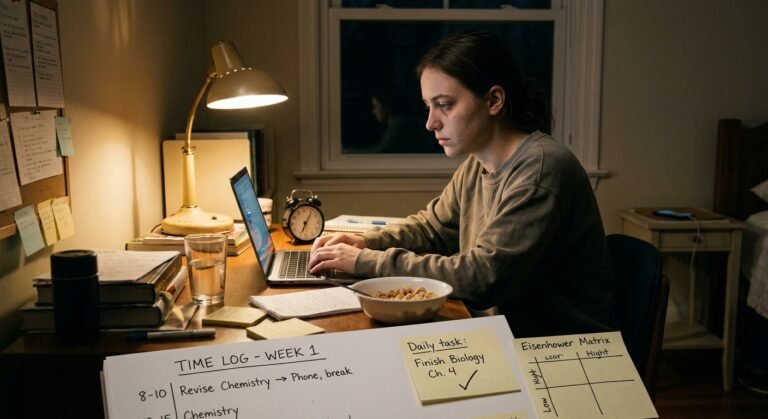
Let me start with a confession. In my second year of college I wrote a 3,000-word essay between 11 p.m. and 6 a.m., fuelled by instant coffee and pure fear. I handed it in, got a decent mark, and told everyone it proved I “work well under pressure.”
It proved nothing of the sort. I was exhausted for three days, I got sick the week after, and the essay was fine only because I got lucky with the topic.
That was my wake-up call, though it took a couple more near-disasters before I really changed anything. What I eventually worked out is that time management isn’t a personality trait. The calm, organised students I used to envy weren’t built differently. They just had a few boring habits, and boring habits are the ones that work.
So here are ten of them. Some I use to this day, some I tried for a week and dropped, and I’ll tell you which is which. Nobody needs all ten at once.
Why It’s So Hard Right Now
School does the hard part for you. Bells ring, teachers chase you for homework, and your day arrives pre-built. Then you hit college (or the last years of school) and the scaffolding vanishes. You might have one lecture on a Wednesday and then nothing until Thursday. Nobody checks on you. Freedom feels amazing for about two weeks, then the deadlines start stacking up.
The other trouble is that deadlines are far away. A paper due in five weeks doesn’t feel real. You picture some future version of yourself who’ll be calm, focused and well rested. That person never shows up, by the way. It’s always just you, the night before, eating cereal for dinner.
A lot of what students call “my own laziness” actually has other causes:
| What it feels like | What’s usually behind it |
|---|---|
| Cramming the night before | No plan for the weeks leading up |
| Tired all the time | Random sleep and study hours |
| “I’m busy but nothing gets done” | Lots of small leaks (phone, chatting, drifting) |
| Forgetting deadlines | Trusting your memory instead of writing it down |
| Guilt when you relax | No clear moment where work counts as “finished” |
None of that is a character flaw. It’s a setup problem, and setups can be changed.
Tip 1: Find Out Where Your Time Actually Goes
I resisted this one for ages because it sounded tedious. It is a bit tedious. It’s also the most eye-opening thing on this list.
For one week, write down what you’re doing every couple of hours. A notebook is fine, so is the notes app. Don’t try to be good, and don’t edit the truth. Just write it.
When I finally did it, I found I was spending close to two hours a day on my phone without having any memory of doing so. Two hours! I’d have sworn it was twenty minutes.
Here’s roughly what mine looked like:
| Time | I planned to | I actually did | Result |
|---|---|---|---|
| 8–10 a.m. | Revise chemistry | Phone, then a long breakfast | Lost about 1 hr |
| 10–12 | Lecture | Lecture | Fine |
| 12–1 p.m. | Lunch | Lunch plus a very long chat | Lost 30 min |
| 4–6 p.m. | Assignment | Assignment, actually focused | Nice |
| 8–10 p.m. | Reading | Watched two episodes of a show | Lost 2 hrs |
You’re not collecting evidence to feel guilty about. You’re looking for leaks. Once you see where the hours go, you can fix them, or at least enjoy that show on purpose instead of by accident.
Tip 2: Make Your Goals Specific Enough to Picture
“I’m going to study more this semester.” I said that every single term. I’m not sure it ever resulted in a single extra minute of studying.
The trouble is that it gives you nothing to do on Monday morning. Compare it with “finish chapters four and five of biology by Friday.” Now you know exactly what done looks like.
I think of goals in three layers:
- Big goal: what you want by the end of the term
- Weekly goal: the piece that gets you closer
- Daily task: the small thing for today
If you want to pass physics, the week’s goal could be two past papers, and today’s task could be ten problems from one chapter. Ten problems is doable. “Pass physics” is just a cloud hanging over you.
Tip 3: Sort Your Tasks Before You Start
Not everything on your list matters equally, which sounds obvious until you spend a whole afternoon replying to messages while your actual assignment sits there glaring at you.
A simple way to sort things is the Eisenhower Matrix. It’s named after a president who apparently had a lot to juggle, and it’s basically a four-box grid:
| Urgent | Not urgent | |
|---|---|---|
| Important | Do now. Assignment due tomorrow, exam this week | Schedule it. Revision, reading, long projects, exercise |
| Not important | Keep it short. Most messages, small favours | Let it go. Endless scrolling, random browsing |
The box that matters most is the top right: important but not urgent. Nothing screams at you to do that work, which is exactly why it gets skipped. And it’s the work that actually builds your grades. If you only ever respond to what’s urgent, you’ll spend your whole degree in panic mode. Put time for the top-right box in your calendar first, before anything else grabs it.
Tip 4: Plan the Week, Not Only the Day
For a long time I wrote daily to-do lists. They felt productive. The problem is that by the time you write Tuesday’s list, Monday has already happened, and you can’t see the deadline looming on Friday.
Now I spend about ten minutes on Sunday evening looking at the whole week. Fixed things go in first (classes, work shifts, that dentist appointment), then I fit study blocks into whatever space is left.
Something like this:
| Day | Morning | Afternoon | Evening |
|---|---|---|---|
| Mon | Classes | Maths study | Light reading, gym |
| Tue | Classes | Assignment work | Free |
| Wed | Classes | Biology study | Go over the week’s notes |
| Thu | Classes | Group project meeting | Assignment work |
| Fri | Classes | Catch-up | Friends |
| Sat | Slow start, short study | Free | Free |
| Sun | Rest | Plan next week | Early night |
You’ll notice there’s gaps. That’s deliberate. The first time I made a weekly plan, I packed every hour, and it collapsed by Tuesday lunchtime because a bus was late. Leave some slack. Things will go wrong, and the slack is where they land.
Tip 5: Work in Short Sprints and Actually Rest
Studying for four hours in one go sounds impressive. In practice it’s usually an hour and a half of work, and the rest is you reading the same paragraph six times.
What worked for me was short sprints. The famous version is the Pomodoro Technique: 25 minutes of work, 5 minutes off, and after four rounds a longer break. Honestly, 25 minutes was too short for me when I was writing. I’d just get going and the timer would go off. So I tweaked it.
| Style | Work | Break | Good for |
|---|---|---|---|
| Classic Pomodoro | 25 min | 5 min | Reading, memorising, getting started |
| Longer focus | 50 min | 10 min | Essays, coding, maths problems |
| Tiny sprint | 15 min | 3 min | Days when you can’t be bothered |
| Deep session | 90 min | 20 min | Big projects, once you’re in the zone |
Try a few and see what feels right. The one rule is that breaks should be real ones. Stand up, get water, stare out of the window like a thoughtful person. If you open Instagram “for a sec,” it won’t be a sec, and your brain won’t have rested at all.
Tip 6: Deal With Your Phone Before It Deals With You
I’m not going to tell you to throw your phone in a lake. I like my phone. You probably like yours.
But thousands of very clever people are paid to make sure you keep picking it up, and your willpower is one tired student at 9 p.m. It’s not a fair fight. So stop relying on willpower and make distraction a bit annoying instead:
- Put the phone in another room while you study (the bedroom works)
- Switch off notifications apart from calls
- Use a blocker app or your phone’s focus mode
- Log out of social media so opening it takes effort
- Charge it outside your bedroom at night
The last one made a bigger difference than I expected. I bought a cheap alarm clock for about the price of a sandwich, and my phone now sleeps in the hallway. I stopped scrolling in bed, I fell asleep faster, and mornings got easier.
If you’re doubtful, try it for three days. Keep the phone in a drawer during study time and see how much gets done. Most people are a bit embarrassed by the result.
Tip 7: Cut Big Tasks Into Small, Ugly Pieces
“Write research paper” isn’t one task. It’s about twenty tasks hiding under one name. No wonder you end up reorganising your desk instead.
The fix is to break it down until the first step feels almost silly. Here’s how I’d split a research paper now:
| Step | What to do | Roughly how long |
|---|---|---|
| 1 | Pick a topic, write one sentence about it | 20 min |
| 2 | Find five decent sources | 1 hr |
| 3 | Read and take notes | 2 hrs |
| 4 | Sketch a rough outline | 45 min |
| 5 | Write a terrible first draft | 3 hrs |
| 6 | Leave it alone (a day if you can) | – |
| 7 | Edit and fix the structure | 1.5 hrs |
| 8 | Proofread, add references | 1 hr |
Look at step five. Terrible is the point. A big reason I put things off for years was that I wanted the first version to be good, so I never wrote a first version. A bad draft is something you can improve. A blank page isn’t.
When you really can’t start, try the two-minute trick: promise yourself two minutes, then stop if you want. You almost never stop.
Tip 8: Learn to Say No (Nicely)
This was my weakest area. I said yes to everything. Group project? Sure. Help you move flat on Saturday? Of course. Join the society committee? Why not, what’s one more thing.
Then I’d wonder why I never had time.
Every yes is also a no to something else, and often that something is sleep, or revision, or your own sanity. You don’t have to be rude about it. A few lines that have worked for me and friends:
| Situation | What you can say |
|---|---|
| A friend wants to go out the night before an exam | “I’d love to, but I’ve got a test tomorrow. Saturday instead?” |
| A classmate wants you to cover their part | “I can’t take extra this week, but I’m happy to help you plan it.” |
| Family asks for a favour in exam week | “I’m swamped until Friday. Could it wait until after?” |
| A club wants you on another committee | “Thanks for asking, but I need to focus on studying this term.” |
Funnily enough, people respect it. Friends don’t vanish. And you turn up to the things you do say yes to in a better mood.
Tip 9: Don’t Wreck Your Sleep, Food and Movement
I know. You want to skip this one. I always did, and it’s probably the most important thing here.
You can have the neatest timetable in the world, but if you’re running on four hours of sleep, energy drinks and noodles from a packet, you’ll struggle to follow any of it. Your brain files away what you’ve learned while you sleep. That all-nighter before an exam? You usually remember less, think slower and make dumb mistakes. Most young adults need somewhere around seven to nine hours.
Food and movement don’t need to be fancy either. A twenty-minute walk can clear your head better than a fourth coffee.
| Habit | Aim for | Why bother |
|---|---|---|
| Sleep | 7 to 8 hours, similar times each night | Memory, mood, focus |
| Water | A glass with meals, a bit extra between | Fewer headaches, less tiredness |
| Meals | Three regular ones, breakfast included | Steady energy for studying |
| Movement | 20 to 30 minutes, most days | Less stress, sharper focus |
| Screen-free wind-down | 30 minutes before bed | Easier to fall asleep |
Please don’t treat these as rewards you earn after studying. They’re part of the study plan, since they’re what makes the studying work in the first place.
Tip 10: Review Weekly and Go Easy on Yourself
Your first plan will be wrong. Mine always is. Maybe the assignment took twice as long as you guessed, or maybe you discovered you’re useless after 8 p.m. That’s not failure, it’s useful information.
What I do now, usually on Sunday with a cup of tea, is a ten-minute check-in. I ask myself a few questions and answer honestly:
| Question | Why it helps |
|---|---|
| What went well this week? | Shows what to keep doing |
| What didn’t get done, and why? | Tells you if the plan was unrealistic or you got distracted |
| What took longer than I expected? | Makes your next estimate better |
| What’s one small change for next week? | Keeps things manageable |
Pick one or two changes, no more. I once tried to overhaul everything in a single week (new sleep schedule, new study routine, no phone after 8) and it all fell apart by Wednesday. Small tweaks stick better.
And when you have a bad day, or a bad week, which you will, don’t turn it into a story about who you are. Start again the next morning. That’s genuinely the whole trick.
All Ten, on One Page
Save this to your phone if it’s useful:
| # | Tip | In one line |
|---|---|---|
| 1 | Track your time | You can’t fix leaks you can’t see |
| 2 | Set clear goals | Specific beats vague, every time |
| 3 | Prioritise | Protect the important-but-not-urgent work |
| 4 | Plan weekly | Look at the whole week, leave slack |
| 5 | Use sprints | Short focus, real breaks |
| 6 | Tame your phone | Make distraction harder |
| 7 | Break tasks down | Small and messy beats big and perfect |
| 8 | Say no nicely | Every yes costs something |
| 9 | Look after yourself | Sleep, food, movement come first |
| 10 | Review weekly | Adjust a little, skip the guilt |
Where to Start
If this feels like a lot, ignore most of it. Pick one tip. Just one. Track your time for a few days, or put your phone in another room tonight. Get comfortable with that, and then try the next.
I’m not a naturally organised person, and I still lose my keys at least once a week. But I haven’t pulled a proper all-nighter in years, my work goes in on time, and I have evenings free again. That’s all I wanted from time management in the first place.
You can get there too. Start small, start this week, and be kind to yourself while you figure it out.
