


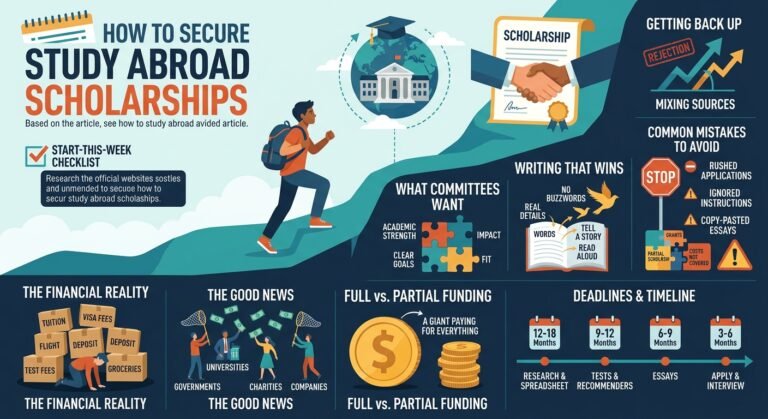
Okay, real talk. Studying abroad costs a lot. Not “skip a few coffees” a lot. More like “my parents are looking at me funny over dinner” a lot.
Tuition is the obvious bit. Then the extras show up one by one: visa fees, a flight, a deposit for a room, test fees, health insurance, a proper winter jacket, and groceries for the weeks before any money comes in. If you’ve been quietly adding this up and feeling a little sick, you’re not alone.
Want to “Study Abroad Scholarships” so,
Here’s the good news, though. Scholarships exist. Loads of them. Governments, universities, charities, and companies give out huge amounts of money every year to students from other countries. Some awards are small. Some pay for literally everything, flights included.
And the people who win them? Not all geniuses. A lot of them are just the ones who started early, kept track of deadlines, and wrote something that sounded like an actual human being.
So let’s get into it.
So What Counts as a Study Abroad Scholarship?
Simple version: it’s money for your education that you don’t pay back. A loan is borrowed. A scholarship is a gift (well, a gift you have to work hard to win).
They come from four main places, and it helps to know which one you’re dealing with because the rules change a lot.
| Source | Who’s behind it | What it usually looks like | Competition |
|---|---|---|---|
| Government | A country’s education ministry or foreign office | Often full funding, with goals like cultural exchange or development | Very high |
| University | The school you apply to | Tuition discounts, merit awards, sometimes full rides | Medium to high |
| Foundations and charities | Private trusts, NGOs, donors | Mixed: small grants up to major awards | Varies a lot |
| Companies and organizations | Corporations, professional bodies | Often tied to a field or a specific group of students | Often lower |
Spend a little time figuring out which bucket suits you. It saves a ton of wasted effort.
Full Funding vs. Partial Funding
People hear “scholarship” and picture a free ride. Those exist, but they’re the hardest ones to get. Don’t write off the smaller stuff, because partial awards add up fast.
| Fully funded | Partially funded | |
|---|---|---|
| Usually covers | Tuition, monthly stipend, flights, often insurance | Part of tuition, or only living costs, or a fixed yearly amount |
| Difficulty | Brutal. Thousands apply for a handful of places | Much more reachable |
| Can you stack them? | Rarely | Often yes (check the rules!) |
| Best for | Your “dream” applications | Your realistic safety net |
My honest suggestion: aim high with two or three big ones, and then build a solid backup list of mid-sized awards. That way you aren’t putting your whole future on one email from one committee.
Scholarships Worth Knowing About
There are thousands of scholarships out there, and no article can list them all. These are some of the well-known ones that regularly support international students. Details, countries, and deadlines change, so treat this as a starting map and always check the official site.
| Scholarship | Country | Level (generally) | What’s it known for |
|---|---|---|---|
| Fulbright | United States | Graduate, research, teaching | Prestigious, often applied for through a local commission or embassy |
| Chevening | United Kingdom | One-year master’s | Looks for leadership and work experience |
| Commonwealth Scholarships | United Kingdom | Master’s, PhD | For students from Commonwealth countries, with a strong development focus |
| DAAD | Germany | Master’s, PhD, research | Wide range of programs, with monthly stipends |
| Erasmus Mundus Joint Masters | Europe (multi-country) | Master’s | Study in more than one country in a single degree |
| Australia Awards | Australia | Varies | Aimed at students from developing countries |
| MEXT | Japan | Undergrad, master’s, PhD, research | Sometimes includes language training first |
| Chinese Government Scholarship (CSC) | China | Bachelor’s, master’s, PhD | Covers tuition, housing, and a monthly allowance |
| Türkiye Burslari | Turkey | Bachelor’s, master’s, PhD | Open to many nationalities, includes language courses |
| Stipendium Hungaricum | Hungary | Bachelor’s, master’s, PhD | For students from partner countries |
| Swedish Institute Scholarships | Sweden | Master’s | Leadership and sustainability themes |
| Gates Cambridge, Rhodes, Knight-Hennessy | UK / US | Graduate | Legendary and extremely competitive |
A quick thought on that last row. Those are brilliant if your profile fits. But I’d never build an entire plan around them. Think of them as lottery tickets you’ve worked very hard to deserve.
Where to Actually Look
Most people don’t miss out because they aren’t good enough. They miss out because nobody told them an opportunity existed until the deadline was gone.
So here’s where I’d poke around, in this order:
- University websites. Look for pages called “Funding,” “Fees and Scholarships,” or “International Students.” Boring name, buried treasure.
- Government portals. Search for the education ministry of the country you’re interested in. Many have a scholarship section.
- Your own country’s education agencies. Plenty have programs or advisors for students heading overseas.
- Scholarship search platforms. Handy for discovery. But always, always double-check on the official page.
- Teachers and professors. They hear about things. Ask them.
- Professional associations in your field.
One warning I can’t skip: if something calls itself a scholarship but wants you to pay a fee to “unlock” it or “process” it, run. Real scholarships don’t charge you to be considered.
Deadlines Come Earlier Than You Think
This catches almost everybody. A lot of big scholarships open up around a year before the program even starts. Want to begin next September? Some deadlines could land this autumn.
Here’s a rough way to plan it backward.
| When | What to do |
|---|---|
| 12 to 18 months before | Research programs and scholarships. Start a spreadsheet with deadlines and links. |
| 9 to 12 months before | Book language and entrance tests (IELTS, TOEFL, GRE, GMAT, whatever you need). Ask your recommenders. |
| 6 to 9 months before | Draft your personal statement and essays. Rewrite them. Then rewrite again. |
| 3 to 6 months before | Submit applications. Gather transcripts and documents. Practice for interviews. |
| After you submit | Keep applying elsewhere. Don’t sit around waiting for one reply. |
Yes, it’s a lot. But breaking it into chunks makes it far less scary than it looks as one giant mountain.
What Committees Are Really Looking For
Every scholarship says it wants “excellent candidates.” What does that mean in real life? Usually a mix of these things:
| What they want | What it really means |
|---|---|
| Academic strength | Decent grades, yes, but rarely the only thing that matters |
| Leadership | Not just “class president.” Organizing something, helping people, starting something small counts |
| Clear goals | Why this degree, why this country, what happens after |
| Impact | Proof you’ll use what you learn to help others or your community |
| Fit | Your story matches what the scholarship itself stands for |
That last one trips up so many people. If you send the same copy-pasted essay to ten places, the readers can tell. They read hundreds of these. They’re not fooled.
Writing a Personal Statement That Doesn’t Put Readers to Sleep
Picture someone reading 200 essays over a long weekend. By essay number forty, everything blends together. “Ever since I was a child, I have been passionate about…” Yawn. Don’t be that essay.
A few things that tend to help:
Open with something real. Skip “I am passionate about public health.” Instead, describe the moment you saw someone travel hours to reach a clinic. Details stick in people’s heads. Generalities slide right off.
Connect the dots. Where you came from, what you’ve done, where you’re going. When those three line up, your story feels like a story and not a list.
Be honest about the messy parts. A bad semester, a gap year, a failure. Say what happened and what you learned. Readers usually trust that more than a spotless record.
Say why this scholarship, specifically. Mention something about the program or the country that actually matters to you.
Drop the buzzwords. “Hardworking,” “dedicated,” “motivated” prove nothing. Examples prove things.
Read it out loud. Stiff sentences are easy to hear and hard to see. If it sounds weird when you say it, change it.
Recommendation Letters (Choose Carefully)
A glowing letter from someone who barely knows you is worth less than a warm, specific one from someone who’s seen you work. A big title doesn’t beat a real relationship.
When you ask, make it easy for them. Here’s what to hand over:
| Give them | Why it helps |
|---|---|
| Your CV or résumé | So they remember everything you’ve done |
| Your draft statement | So their letter matches your story |
| The scholarship details | So they know what the committee values |
| A short list of achievements | Gives them specific things to mention |
| At least four weeks | Nobody writes a good letter in a rush |
And send a polite nudge as the deadline gets closer. People are busy. A friendly reminder is completely normal.
Interviews Aren’t as Scary as They Sound
Some scholarships (Chevening and Fulbright, for example) include an interview. Your stomach might flip just reading that. But think about it: it’s a conversation about subjects you already know better than anyone, which is you.
Practice questions like these:
| Likely question | What they’re checking |
|---|---|
| Why this subject, and why this country? | Whether you’ve thought it through |
| Tell us about a time you led something. | Real leadership, not just titles |
| What will you do when you return home? | Whether you plan to use your education |
| What challenges might you face abroad? | Maturity and realism |
Say your answers out loud to a friend, a teacher, or even your bathroom mirror. Don’t memorize scripts. Just get comfortable enough that you won’t freeze.
Mistakes That Quietly Wreck Applications
Everyone nods along to advice like this and then makes the same errors anyway. So here they are, with the fixes.
| Mistake | Quick fix |
|---|---|
| Applying at the last minute | Set your own deadline two weeks earlier than the real one |
| Ignoring the instructions | Check word limits, file types, and formatting before submitting |
| Sending generic essays | Tailor each one to the specific scholarship |
| Typos and sloppy grammar | Proofread, then ask someone else to proofread |
| Rushed recommendation letters | Ask early, and give recommenders what they need |
| Applying to only one or two awards | Spread out. Apply to many |
| Skipping the eligibility rules | Read the criteria twice. Some need work experience or specific nationalities |
| Underselling yourself | Your achievements count more than you think |
That last mistake is a sneaky one. Plenty of strong applicants talk themselves out of it because their accomplishments don’t feel “big enough.” Let the committee decide that.
Mixing Funding Sources
You don’t need one perfect scholarship. Lots of students build a funding package out of several pieces:
| Piece | Possible role |
|---|---|
| Partial scholarship | Covers part or all of tuition |
| Smaller award or grant | Helps with living costs |
| Part-time job or research assistantship | Extra income, if your visa allows it |
| Savings or family support | Fills smaller gaps |
| Education loan | Last resort for what’s left, borrowed carefully |
One catch: some scholarships don’t allow you to hold another major award at the same time. Always read the terms before assuming you can stack them.
Costs a Scholarship Might Not Cover
Even a generous scholarship can leave you stuck with surprise expenses. It’s smart to plan for them:
| Cost | Worth remembering |
|---|---|
| Visa and application fees | Often paid before you know the result |
| Health insurance | Sometimes covered, sometimes not |
| Accommodation deposit | Usually due at the start, all at once |
| Winter clothes and household basics | Easy to forget, annoying to buy in a hurry |
| Emergency cash | Keep a cushion for the first few months |
| Return flights | Not always included |
Having a little breathing room saves you stress during the most chaotic stretch of the whole move.
What If You Get Rejected?
Then welcome to the club. Plenty of winners got turned down the first time. A rejection usually means one of three things: the competition was fierce, the match wasn’t quite right, or the application needed more polish. It rarely means you’re not good enough.
Here’s what to do next:
| Step | Why |
|---|---|
| Ask for feedback if possible | Some programs will tell you where you fell short |
| Build your profile | Volunteering, research, work experience, a better test score |
| Rework your essays | Fresh eyes catch things you couldn’t see before |
| Apply again or try new scholarships | Your next application will be stronger |
Persistence sounds like boring advice. It also happens to work.
Is the Effort Worth It?
Honestly? Yes. Even when it’s tiring, and it will be.
A scholarship can mean finishing a degree without debt, working with better researchers, building a real international network, and coming away with options you didn’t have before. And the skills you pick up on the way, like planning ahead, writing clearly, and explaining what you want, stay with you long after the applications are done.
Your Start-This-Week Checklist
If everything above feels like too much, shrink it. Just do these five things this week.
| # | Task |
|---|---|
| 1 | Pick a field of study and two or three countries you’d love to study in |
| 2 | Create a spreadsheet and list ten scholarships you could realistically apply for |
| 3 | Write down every deadline and required document |
| 4 | Find out which tests you need and book one |
| 5 | Write a rough draft of your story. It’s allowed to be terrible |
That’s it. Small steps beat a perfect plan you never begin.
One Last Thing
Study abroad scholarships aren’t magic, and they aren’t only for a lucky few. They go to people who start early, stay organized, and tell an honest, specific story about who they are and where they’re headed. Some of those people had amazing grades. Plenty of others just had a clear reason and the patience to keep going.
So open that spreadsheet. Pick a few scholarships. Write the ugly first draft. A year from now you could be standing in a new city with your tuition already handled, wondering why you waited so long to start.
Heads up: scholarship amounts, rules, and deadlines change from year to year. Always confirm the latest details on each program’s official website before you apply.
