


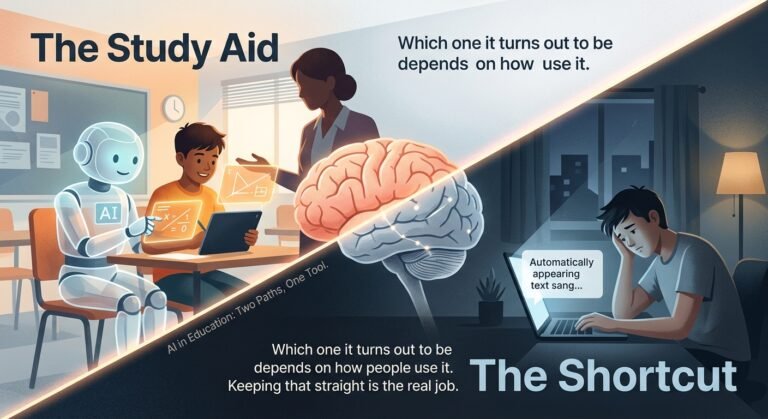
That’s the strange spot education is in right now. AI in Education is the best study aid anyone has ever had and the easiest shortcut anyone has ever had, and it’s the same tool. Which one it turns out to be depends on how people use it.
I want to walk through how we got here, what’s genuinely working, what’s going wrong, and what I think schools should do about it. Some of this is settled fact. Some is opinion, and I’ll try to say which is which.
The robots were already in the building
When ChatGPT arrived in late 2022, you’d have thought computers had never been near a classroom. Schools went into a kind of collective panic. But machines have been teaching people for a very long time.
Back in the 1960s, a team at the University of Illinois built a system called PLATO. Students sat at terminals and worked through lessons, and the machine adjusted what came next based on their answers. It looks quaint now, with its glowing orange screens and its slow clunky hardware. The core idea, though, is exactly what today’s adaptive apps still chase: stop teaching everyone the same thing at the same speed.
Carnegie Mellon researchers spent decades on “cognitive tutors” for maths, software that tracked each step a student took and noticed which specific idea they were missing. These were narrow tools. Ask one about the French Revolution and you’d get nothing. But within their little domain, they worked, and several studies found real improvements, particularly for kids who’d been struggling.
Then the 2010s brought MOOCs, the massive free online courses. Coursera, edX, Udacity. The hype was enormous. Someone predicted universities would be obsolete in fifty years. Millions of people signed up, and the large majority drifted away within weeks. Turns out watching a lecture isn’t the same as learning from it. You need someone to tell you when you’ve gotten it wrong, to push you on days you can’t be bothered, to notice you’ve gone quiet.
That missing piece is what today’s AI is trying to supply. Whether it can is the whole argument.
Why people keep mentioning Benjamin Bloom
If you read much about AI tutoring you’ll run into a 1984 paper by Benjamin Bloom, so it’s worth knowing what he found. His group compared students taught in ordinary classrooms with students taught one-on-one by a tutor. The tutored students did dramatically better, about two standard deviations better, which put the average tutored kid ahead of nearly everyone in the regular class.
He called it the “2 sigma problem,” and the “problem” part was the catch. One-to-one teaching clearly worked, and it was completely unaffordable at scale. You’d need roughly one teacher per student.
Later researchers have argued the real-world effect is smaller than that headline number, and fair enough. Still, the basic finding feels true to anyone who’s lived it. Think about the teacher or relative who sat with you and made something click. You didn’t need two standard deviations of proof. You remember it.
So here’s the pitch behind AI tutors: maybe software can deliver some slice of that attention to everybody. Not all of it. Some of it. For a kid who’d otherwise get none, some of it is a big deal.
Where it’s actually being used
I’ll skip the sales pitch and describe what’s out there.
Adaptive practice is the oldest and quietest category. Khan Academy, Duolingo, and countless maths and reading apps watch how you perform and shift the difficulty. You never think “that’s AI” while you’re using them, but it is, and hundreds of millions of people use it daily.
Conversational tutors are the new arrival. Khan Academy’s Khanmigo, launched in 2023, runs on a large language model but is deliberately built to hold back. Ask it for the answer to an equation and it tends to ask what you think the first step should be. Annoying if you just want to finish. Very good if you want to learn. I’ll return to this because I think it’s the most important design decision in the whole field.
Language learning has benefited a lot. Practising speaking out loud to a person is nerve-wracking, especially as a teenager. Practising with a chatbot at eleven at night, where nobody can laugh at your accent, is a lot easier. It won’t replace real conversation, but it gets people to the point where real conversation feels survivable.
Accessibility might be the least glamorous and most valuable area. Speech-to-text for students who struggle to write, text-to-speech for those with dyslexia, automatic captions, image descriptions for blind students, simplified versions of dense reading. Many of these barriers were treated as simply permanent for years. They aren’t any more.
Then there’s the university side. Georgia State became well known for using data to spot students heading toward dropping out, then sending advisors to talk to them. They also used a chatbot called Pounce to answer questions from incoming students about forms and financial aid. A randomised trial found it cut “summer melt,” the odd phenomenon where students get accepted, intend to attend, and then never show up because of some small paperwork snag nobody explained. A text message fixed that for a lot of people. Small stuff matters.
The teacher’s side of the story
Most of the noise is about students. I think teachers are the bigger story.
Ask a teacher what their job is really like and the answer is rarely “teaching.” It’s marking, planning, emailing, filling in forms, making three versions of a worksheet for three levels of ability, writing report comments for thirty kids who each need to sound like an individual. Surveys in many countries keep finding that teachers work far past their paid hours, and a big chunk of the extra time goes to paperwork.
AI is genuinely good at paperwork. Ask for ten fractions questions at three difficulty levels, a reading passage rewritten for younger readers, a first draft of a parent email. It’s rarely perfect. Sometimes it’s embarrassingly wrong. But editing something is faster than creating it from nothing, and for a person who’s out of hours, that gap is real.
Grading is where I get nervous. Marking multiple choice by machine is old news and fine. Letting AI hand out grades on essays feels different to me. A comment on a piece of writing is a small conversation between two people. Kids notice when someone actually read their work. Take that away, and you lose something hard to measure but easy to feel. Using AI for a first pass on grammar or structure, sure. Letting it have the last word on a child’s writing, no thanks.
Now, the cheating thing
Yes, students are using AI to do their work. Plenty of them. Pretending otherwise helps nobody.
The first response from many schools was to ban it. New York City’s public schools blocked ChatGPT on school networks in January 2023, then lifted the block that May. The reason isn’t mysterious. Kids have phones. A ban on the school wifi doesn’t stop anything at home.
The second response was detection software, and that’s gone badly. These tools make mistakes in both directions. Researchers at Stanford found that detectors disproportionately flagged writing by non-native English speakers as machine-made, probably because simpler, more cautious phrasing looks “predictable” to the algorithm. Imagine being a student learning English, writing every word honestly, and being accused of fraud by a piece of software. Some universities have since turned the detectors off or told staff not to rely on them.
What seems to work is less exciting. Teachers are bringing more writing into the classroom itself. They’re asking students to explain their thinking out loud. They’re setting tasks tied to something personal or local that a chatbot can’t know about, and collecting drafts in stages so they can see the work develop. And, maybe most useful of all, they’re telling students plainly what’s allowed.
Because here’s the thing. A lot of students honestly don’t know. Is asking AI to brainstorm cheating? Fixing grammar? Explaining a concept you didn’t follow in class? One teacher says yes, the next says go ahead. If adults can’t agree, you can hardly blame a fifteen-year-old for being confused.
The quieter problem
Cheating is the loud worry. The one that keeps me thinking longer is quieter.
Learning is meant to feel a bit hard. There’s a well-established idea in psychology called “desirable difficulty”: you remember and understand things better when you’ve had to struggle for them. Trying to recall something, getting it wrong, checking, trying again. That’s the process. It’s uncomfortable, and the discomfort is doing the work.
Picture two students revising photosynthesis. One asks a chatbot for a summary, reads it, nods, feels great. The other closes the book and tries to explain it from memory, realises they’ve forgotten what happens in the second stage, goes back, tries again. The first one feels more productive. The second one learned more.
Now give both students an AI that’s always on and makes everything smooth. A lot of kids will take the smooth road every time, which is human nature, and I’m not sure we can blame them. But if the struggle disappears, so might the learning.
Early research is mixed, and I’d be wary of anyone who claims it’s settled. Some studies suggest students using AI freely do better during practice and then worse on a later test without it. Others show real benefits when the AI is set up to coach instead of to answer. The pattern so far points one direction: how it’s used matters much more than whether it’s used. That’s why Khanmigo’s habit of asking questions instead of answering is so important. And it’s also why it’s a worry that a student can simply open a different chatbot and ask for the answer.
Who gets the benefit?
New technology tends to help the already-advantaged first. I don’t see why this would be an exception.
The hopeful version is real. A curious kid with a phone and a signal can now get patient explanations on almost anything, at any hour, for little or nothing. In places with few teachers or no tutors, that’s huge.
But reliable internet, a decent device, and a quiet corner to work in are still not universal. Well-funded schools can train their staff, write careful policies and buy better tools. Others get whatever’s free and make do. Most models also work much better in English than in smaller languages, so a lot of the world gets a weaker version.
And there’s a skills gap hiding in here. Students who already know how to ask a sharp question and doubt a shaky answer will get a lot more from AI than students who take whatever it says at face value. So unless schools actively teach those habits, AI could simply amplify the advantages some kids already have.
Wrong answers, hidden bias, and children’s data
AI makes things up. If you’ve spent any time with a chatbot you’ve seen it, a confident answer that turns out to be completely invented. For a student who doesn’t know the subject yet, that’s dangerous, because they can’t tell. Teaching kids to treat AI output as a first draft to check, not a fact to memorise, may be one of the most useful lessons a school can offer now.
Bias is a quieter version of the same issue. These systems learn from huge piles of human writing, which means they absorb our stereotypes along with our knowledge. Examples, stories, even feedback can lean in ways nobody notices unless they’re looking.
And then privacy. Students are children. When a school signs up for an AI platform, somebody should be asking what data gets collected, where it goes, who can see it, and whether it’s used to train future models. Laws like FERPA in the US and GDPR in Europe set some limits, but enforcement is patchy and the technology moves faster than legislation. Parents are right to push on this.
So what do kids need to learn?
If a machine can produce a decent essay in ten seconds, what’s the point of teaching essay writing?
I’d say the point has grown, not shrunk.
Start with judgment. When fluent text is cheap, the scarce skill is knowing whether it’s any good. Is it accurate? Does the argument hold together? What’s been left out? Students need plenty of practice questioning things, not only producing them.
Next, plain old knowledge. People like to say “you can just look it up,” and it was always a bit lazy as an argument, but it’s weaker than ever now. You can’t spot an AI’s mistake about the Second World War if you know nothing about the Second World War. You can’t tell a wrong maths solution from a right one if you don’t understand the maths. Knowledge is what lets you smell nonsense.
Then the human stuff. Working with other people, disagreeing without a fight, staying curious when something is frustrating. A chatbot can’t do those on your behalf.
And writing. Some people now say writing instruction is obsolete. I think the opposite. Writing is thinking you can see. Half the time you don’t find out what you actually believe until you try to put it into sentences. Skip that, and you’ve skipped a way of understanding the world that nothing else replaces.
Where this goes next
Predictions in this area age like milk, so I’ll keep mine small.
AI tutors will get better. Ones that remember where a particular student struggled last month, adjust to how that person learns, and flag a problem to the teacher before it grows are already being built. If they work, teachers might spend less time on forms and more on what only a person can do: encouraging, mentoring, noticing that a kid who’s normally cheerful has gone quiet this week.
Assessment will shift too. Essays written at home and graded alone are harder to trust, so expect more in-class writing, more spoken exams, more projects and portfolios. Honestly, that might measure learning better than the old way did.
And the rules will settle. The ban-it-all phase is fading. Schools are starting to separate uses that help learning from uses that replace it, and they’ll have to keep revising, because the tools won’t hold still.
What won’t change is the part underneath. People learn when they’re curious, when the work is pitched at the right level, and when someone they trust thinks they can do it. Technology can support all that. It can’t stand in for it.
My take
You can be a cheerleader or a doomsayer about this, and I don’t think either is much use.
AI in schools is a strong tool with real upsides and real risks, and most of what happens next comes down to human decisions. How the tools are built. How well teachers are trained and backed up. How clearly schools set expectations. How honestly adults talk to young people about what these systems can and can’t do.
Hand the thinking over to the machine and we’ll raise students who look capable and aren’t. Use it to cut the pointless busywork, widen access, and give more kids the patient attention that used to be a luxury, and it could turn out to be one of the best things to happen to education in a long while.
The machine isn’t the teacher. At its best it’s a helper that gives the teacher more time, and a study partner that nudges a student to think harder instead of thinking for them. Keeping that straight is the real job. No algorithm is going to do it for us.
