


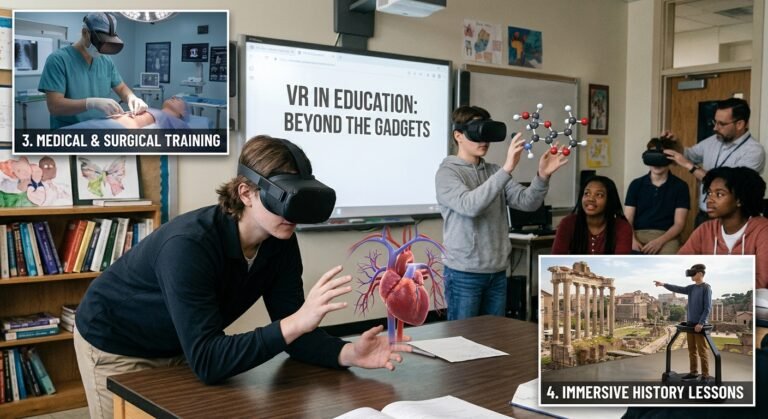
Confession time. I rolled my eyes the first time someone told me VR would change how kids learn.
I’d heard that song before. Interactive whiteboards were going to change everything. Then tablets. Then “smart” everything. Half of those gadgets now live in a cupboard somewhere, under a box of dried-up markers.
So I went looking for the catch. And I found some, which I’ll get to. But I also found schools, hospitals and training centers doing things with VR that made me think, huh, okay, that really is a better way to learn that.
Here are ten real “Examples of VR in Education”. For each one I’ll tell you what’s good about it and where it gets awkward, because nobody needs another gushing sales pitch.
Why would anyone put a headset on a student?
Good question. It’s one more device to charge, wipe down and fix at 8:55 on a Monday morning, right when you have thirty kids and zero patience.
But here’s the appeal. Inside a headset, your brain mostly believes where it is. You turn your head, the world turns with you, and it’s very hard to doodle in the margins. You also get to do things. Ruin an experiment, fail a practice operation, stumble through a fake job interview. Nobody gets hurt, and nobody has to clean anything up. And you can reach places and equipment that would otherwise be too far, too pricey or too dangerous.
Examples of VR in Education at glance
| # | Example | What it helps with | Who’s using it |
|---|---|---|---|
| 1 | Virtual field trips | Geography, history, science | Schools, universities |
| 2 | Virtual science labs | Chemistry, biology, physics | High school, college |
| 3 | Medical and surgical training | Anatomy, procedures, patient care | Medical and nursing students |
| 4 | Immersive history lessons | History, empathy | Middle school and up |
| 5 | Language practice | Speaking, listening | All ages |
| 6 | Special education | Social and life skills | Students with varied needs |
| 7 | Vocational training | Welding, machinery, safety | Trade schools, employers |
| 8 | Virtual classrooms | Remote and hybrid learning | Universities, adult learners |
| 9 | Soft skills practice | Public speaking, interviews | Students, professionals |
| 10 | Design and engineering | 3D modeling, architecture | STEM and design programs |
1. Virtual field trips
Picture organizing a real field trip. Permission slips that come back chewed, crumpled or never. A bus that’s late. A budget someone has to sign off on. One child who’s lost their lunch before you’ve left the parking lot. And if your school is hundreds of miles from the sea, the coral reef trip was never on the table.
A virtual trip skips every bit of that. Students can drift over the Amazon, wander through the pyramids or peer out of the International Space Station’s windows, all without leaving the classroom.
Google Expeditions was the famous early tool for this. Google closed it down in 2021, and plenty of teachers grumbled about it. The idea survived, though. You’ll find similar experiences on Meta Quest headsets, in apps like Nearpod VR, and in a mountain of 360-degree videos online.
Why it works: scale. A kid who has “stood” beneath a blue whale skeleton knows how huge a blue whale is. Reading “up to 30 meters” in a textbook just slides right past you.
Where it flops: when students are dropped into a scene and told to “have a look around.” That’s a slideshow with extra steps. The teachers who get the most out of it give a tiny mission. Find three animals. Sketch the building. Answer one question. A little structure changes everything.
2. Virtual science labs
Real labs are expensive, and I don’t only mean the equipment. Chemicals run out. Glassware gets smashed. Some experiments are too risky for beginners. Lots of schools simply can’t run everything the curriculum expects.
Labster is probably the best-known virtual lab platform. Students work through experiments in a simulated lab, mix chemicals, use a virtual microscope and see what happens. If it all goes wrong, they hit reset. No wasted supplies, no evacuation.
Then there’s Nanome, where students grab 3D molecules with their hands and spin them around. Understanding how a drug fits into a protein is far easier when you can walk around it than when you’re squinting at a flat diagram on page 214.
| Real lab | Virtual lab | |
|---|---|---|
| Cost | Supplies and equipment add up | Cheap to repeat |
| Safety | Real hazards | No physical risk |
| Mistakes | Waste materials | Just restart |
| Realism | Messy and unpredictable (in a good way) | Cleaner, simpler |
| Space needed | A proper lab | Pretty much anywhere |
My honest take: great practice, poor replacement. Kids still need to know what it feels like to pour real liquid into real glassware and end up with a reading that’s slightly off. That small annoyance is part of learning science.
3. Medical and surgical training
If I had to pick the single most convincing use of VR in education, this is it.
The problem is obvious. Surgeons need a huge amount of practice, and nobody wants a trainee’s first go to be on a living human. Cadavers are limited and costly. Standing behind a surgeon and watching only teaches you so much.
VR sits in the gap. Companies like Osso VR and Fundamental Surgery build simulations where trainees walk through procedures step by step and get feedback on their technique. Studies of VR surgical training have often found that trainees perform better and make fewer errors than those trained the traditional way alone. Results vary depending on the study and the procedure, so call it promising rather than miraculous.
Nursing programs use it too. Imagine looking after a patient whose condition is slowly getting worse. You make a call, see what happens, then run it again and try something different. Thinking fast under pressure is hard to practice any other way without putting a real person at risk.
The big win is repetition without consequences. You can do it badly, work out why, and try again.
4. Immersive history lessons
History has an image problem. For a lot of people it’s a heap of dates they crammed for an exam and forgot by the weekend.
VR gives the past a setting. One of the most talked-about examples is The Anne Frank House VR, which recreates the secret annex where Anne Frank and her family hid during the war. It’s small and quiet, and it lands harder than most textbook paragraphs ever could. Other projects let students wander through ancient Rome, medieval towns or places that no longer exist.
Teachers often mention empathy. Once you’ve stood in a space, even a digital one, the people in the story stop being names and start being people. The discussions afterward tend to be better, too, because everyone in the room just went through the same thing.
One caution. Every historical VR experience is somebody’s interpretation. Someone decided what to put in and what to leave out. A good teacher gets students asking who made it, what was simplified and what we honestly don’t know.
5. Language practice
You’ve heard the advice. The best way to learn a language is to go and live where it’s spoken. Brilliant. Thanks. Most of us can’t just pop off to Madrid for six months.
VR gets you part of the way. Apps like Mondly VR and ImmerseMe put you in everyday situations: ordering coffee, asking for directions, checking into a hotel. You actually have to speak, and some apps listen and correct your pronunciation.
It helps for a few reasons. Phrases learned in context tend to stick better than word lists. Talking to a virtual character is much less cringe-inducing than talking to a classmate, which matters if you’re shy. And you can replay a scene until it feels natural.
It’s not perfect. Speech recognition can trip over accents, and virtual characters don’t react the way real people do. I’d treat it as speaking practice you can do at midnight in your pajamas, not a substitute for talking to actual humans.
6. Special education and inclusive learning
For many students with learning differences, the real world can be loud, fast and unpredictable. VR can offer something calmer: a controlled space where a situation can be slowed down and repeated as often as needed.
Floreo is one program designed to help autistic learners practice social skills and everyday situations, like crossing a street, greeting someone or getting through a busy public place, before facing them for real. Because the environment is predictable, confidence can grow bit by bit.
VR is also used to teach daily-living skills such as shopping or taking public transport, to offer calm spaces for students who get overwhelmed, and to open up experiences for students with physical disabilities that would otherwise be out of reach.
A note of care here. Some students find headsets overstimulating, and what works for one learner may not work for another. This is an area where you go slowly, plan with specialists and families, and resist rolling it out to everyone just because you can.
7. Vocational and technical training
Some trades are expensive and risky to learn on the real thing. Welding eats through metal and gas. Heavy machinery can seriously hurt people. Aircraft maintenance needs access to equipment most schools will never own.
Simulators have been part of these fields for ages. Welding simulators, such as the ones from Lincoln Electric, let students practice torch angle and speed before they touch real metal. Employers use VR too. Strivr, for example, has worked with large companies on safety and customer-service training.
| Trade | What the simulation covers | The main benefit |
|---|---|---|
| Welding | Torch angle, speed, bead quality | Saves materials, instant feedback |
| Heavy equipment | Cranes, excavators | Safe practice before the real thing |
| Electrical work | Wiring, troubleshooting | No risk of shock |
| Aviation | Engine and aircraft inspection | Access to costly equipment |
| Emergency response | Fires, hazards | Rehearse the stressful bits safely |
Nothing replaces real hands on real tools. But VR can shorten the learning curve and make those first clumsy attempts a lot safer, and for a beginner that’s worth a lot.
8. Virtual classrooms and campuses
Anyone who survived remote learning knows how flat a grid of faces on a screen can feel. VR tries something else: a shared 3D space where students show up as avatars, move around, and interact with each other and with objects.
Platforms like Engage and VictoryXR support virtual classes and presentations. Morehouse College piloted VR “metaverse” classrooms with VictoryXR, where students attended some courses in virtual form. A few universities also run virtual open days, so prospective students can look around from their sofa.
The good bits: it feels more like being in the same room, it’s great for spatial subjects (walking around a model of the solar system beats a diagram any day), and it helps students who live far from campus.
The less good bits: not every student owns or can afford a headset, long sessions can cause tiredness or motion sickness, and teachers end up with extra setup and tech support on top of an already overflowing job.
I’d call this one promising but clunky. It’s best for specific activities, not as a stand-in for an entire class.
9. Soft skills and public speaking
Lots of people would happily do almost anything other than stand up and give a talk. VR makes practicing a lot less miserable.
VirtualSpeech and similar tools put you in front of a virtual audience, anything from a small meeting room to a packed hall. You give your talk, and the software can track your pace, your filler words and where you’re looking. Other programs simulate job interviews, difficult conversations and customer-service situations.
The clever part is that it feels real enough to get your heart pounding, but nobody’s actually judging you. You can bomb a practice run, restart and try again in private. Universities use it for career readiness, and companies use it for leadership and communication training. Of all ten examples, this might be the simplest and most practical.
10. Design, engineering and architecture
Designers have always had the same headache: they have to picture things that don’t exist yet. VR lets them step inside their ideas.
An architecture student can walk through a building they designed before anyone has laid a brick, and realize straight away that the corridor’s too narrow or the room’s too dark. Engineering students can rotate a 3D machine and look inside it. Gravity Sketch (3D sketching in VR) and zSpace (stereoscopic 3D screens with tracked pens) are used in classrooms and design programs.
It saves timeand money, too. Testing an idea in VR is quicker than building a physical prototype every time, and abstract things like geometry and mechanics become objects you can pick up and turn over.
What VR does well
Looking across all ten, the same strengths keep turning up:
| Benefit | In plain English |
|---|---|
| Engagement | Students are doing, not just listening |
| Memory | Experiences tend to stick better than lectures alone |
| Safe practice | Mistakes happen in a simulation |
| Access | Faraway places and pricey equipment come within reach |
| Pace | Learners can repeat things as often as they need |
| Empathy | Stepping into another place helps you understand it |
The problems nobody should skip
I don’t want to oversell this. VR has real drawbacks, and ignoring them is exactly how a school ends up with thirty expensive paperweights.
| Challenge | What it looks like | A sensible response |
|---|---|---|
| Cost | Headsets, licenses, charging, storage | Start with a small shared set |
| Content quality | Plenty of VR apps aren’t educational or accurate | Test everything before class |
| Motion sickness | Some people get dizzy or queasy | Short sessions, comfort settings, breaks |
| Age limits | Many makers set minimums, often 10 or 13 | Check the manufacturer’s rules |
| Teacher training | Teachers need time to learn the tools | Offer training and trial time |
| Equity | Not every student has the same access at home | Use VR at school, keep alternatives |
| Privacy | Devices and apps can collect data | Read the policies, follow school rules |
And the point that matters most: if a book, a video or a good discussion would teach the same thing just as well, use that. VR has to earn its place in a lesson. Looking impressive doesn’t count.
How to start without wasting money
If you’re curious, here’s what I’d do.
- Start with the learning goal, not the gadget. Decide what you want students to understand, then ask honestly whether VR is the best route.
- Go small. Try one lesson with one class before buying anything for the whole school.
- Pick standalone headsets. The ones that don’t need a computer are far easier to set up and look after.
- Plan the whole lesson. Introduce the topic, do the VR part, then talk about it. A big chunk of the learning happens in that conversation.
- Keep it short. Fifteen to twenty minutes is often plenty, especially for younger students.
- Ask the students. They’ll tell you very quickly what worked and what was just noise.
Where this is heading
The tech keeps improving. Headsets are lighter and more comfortable than they used to be, and mixed reality devices blend virtual objects into the room you’re actually standing in. AI is making virtual characters more responsive, which could make language practice and interview training feel far more natural than it does now.
Prices will probably keep dropping, and that will bring more schools in. The bigger question is quality. Will we get experiences that teach well, or ones that just look flashy? My guess is the best results will come when teachers and developers sit down and build things together, instead of developers guessing what a classroom needs.
So, is VR worth it?
Sometimes, yes. It won’t replace teachers, and it shouldn’t try. But for the right job, like practicing surgery, visiting somewhere you could never afford to go, or rehearsing a terrifying presentation, it can do things a worksheet can’t.
If you’re curious, please don’t buy thirty headsets on day one. Pick one subject, try one well-made experience, and watch what your students do. If they lean in, ask questions and keep talking about it afterward, you’ve found something. If they’re bored in five minutes, that’s useful to know too, and it was a cheap lesson.
