


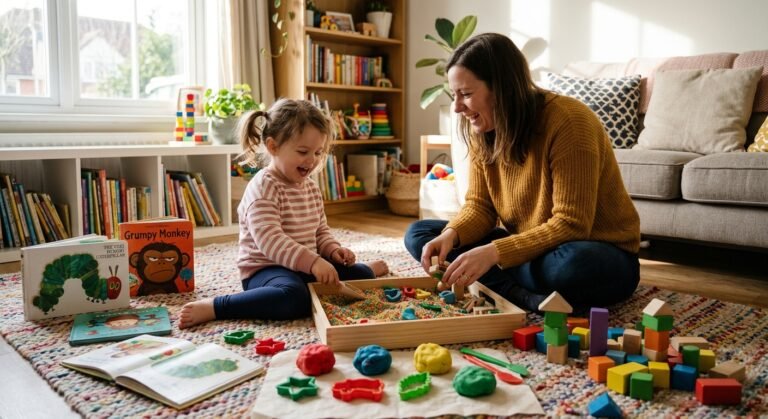
There’s a particular kind of afternoon that every parent of a three-year-old knows. It’s 2:40pm. Lunch is over, nap either didn’t happen or happened too well, and bedtime is a very long way off. The living room looks like a toy shop got hit by weather. And a small person is standing in front of you, saying the words nobody wants to hear: “I’m bored.”
This list is for that afternoon.
Three is a strange, brilliant age. They can finally tell you what they think, and what they think is mostly “no.” They ask why the sky is blue, why the dog has a tail, why you can’t just have ice cream for dinner. They also learn at a pace that’s honestly a bit unfair to the rest of us. You turn around to make a cup of tea and they’ve figured out how to open the cupboard.
Here’s the good news: you don’t need to buy much. Most of these educational activities use things you’ve already got, like a baking tray, some old socks, a bag of rice at the back of the cupboard. I’ve tried to keep the setup short, because a craft that takes forty minutes to prepare and gets four minutes of attention is a bad deal for everyone.
One thing to know before you start. At this age, learning rarely looks like learning. It looks like pouring water from one cup to another for twenty minutes, or building a tower purely so it can be demolished. That’s not wasted time. That’s the work.
All Fifteen Educational Activities at a Glance
Skim this, pick one that suits your mood (yours, not theirs), and go.
| # | Activity | What it quietly teaches | How long | Mess |
|---|---|---|---|---|
| 1 | Sensory bin | Finger control, new words | 15-20 min | Medium |
| 2 | Water pouring | Early maths, hand strength | 15-25 min | Lots |
| 3 | Playdough | Fine motor skills, imagination | 15-30 min | Little |
| 4 | Sorting game | Grouping, logic | About 10 min | Little |
| 5 | Counting real things | Number sense | All day long | None |
| 6 | Chunky puzzles | Patience, problem solving | 10-15 min | None |
| 7 | Blocks and boxes | Spatial thinking | 15-30 min | Little |
| 8 | Reading together | Language, listening | 10-20 min | None |
| 9 | Songs and rhymes | Memory, sounds in words | 5-10 min | None |
| 10 | Puppet stories | Sequencing, feelings | 10-15 min | Little |
| 11 | Painting | Self-expression | 15-20 min | Lots |
| 12 | Collage | Making choices, fine motor | 15-20 min | Medium |
| 13 | Obstacle course | Balance, following directions | 15-20 min | Little |
| 14 | Kitchen helper | Independence, order of steps | 15-30 min | Medium |
| 15 | Scavenger hunt | Noticing things, vocabulary | 20-40 min | Little |
Squishy, Pourable, Messy Stuff
1. Sensory Bin
Find a baking tray or a plastic tub with decent sides. Fill it with dry rice, oats, or pasta. Add a couple of spoons, a few little cups, and bury some small toys at the bottom for treasure hunting.
That’s the whole recipe. And it works far better than it has any right to. Kids who can’t sit still for a story will happily dig around in a tub of lentils for half an hour. Meanwhile they’re getting practice at gripping, scooping, and pouring, and picking up words like “heavy,” “tiny,” and “overflowing” without anyone teaching them.
Keep an eye on it, though. If your child still puts everything in their mouth (and plenty of three-year-olds do), stick to big pieces and stay close.
2. Water Pouring
Half-fill a tub with water. Hand over some cups, a funnel, a sponge, maybe a turkey baster if you own one. Put a towel underneath. Then accept that everyone’s sleeves are going to get wet.
It looks like splashing, but there’s actual science happening. They’re discovering that a tall thin cup holds a different amount than a short wide one, and that water always, always goes down. It also builds the hand and wrist strength they’ll need for holding a pencil later. If the weather’s decent, take it outside and the mess becomes the garden’s problem.
3. Playdough
If I had to keep only a handful of things from this list, playdough would make the cut. Squashing, rolling, pinching, and poking all work the tiny muscles in the hands, and those muscles are the same ones that will eventually write their name.
Ask them to make dinner for a teddy, or a snake for everyone in the house, and suddenly you’ve got storytelling and counting too. Nobody told them that was the plan.
You can make it from scratch: two cups of flour, one cup of salt, two tablespoons of oil, and about a cup of warm water. Mix it, knead until it stops being sticky, and keep it in a sealed container. It lasts around a week.
Maths Without the Worksheets
4. Sorting Game
Tip out a mixed pile of safe things: big buttons, coloured bottle tops, odd socks, toy cars. Then ask for “all the red ones over here” or “every big one in this pile.”
It feels like tidying up, but it’s really the first step towards maths. Before a child can get their head around numbers, they need to understand that things can belong together because they share something. Start with colour, move on to size, and if they invent their own rule (they will, and it’ll make no sense), ask them to explain it. The explanations are usually the best part.
5. Counting Real Things
Skip the flashcards. Count the stairs as you climb them. Count the grapes going into the lunchbox. Count toes in the bath, and then count them again because it’s apparently hilarious every single time.
Lots of three-year-olds can chant “one, two, three, four, five” like a song without realising each number matches an actual thing. What makes it click is touching objects one at a time while you count. That’s all you’re aiming for. Up to ten is plenty.
6. Chunky Puzzles
Four to twelve big pieces is the sweet spot, ideally the wooden kind with little knobs to grab.
Here’s the hard part: when they get stuck, you have to sit on your hands. The urge to grab the piece and fix it is enormous. Try “what if you turn it round?” instead, then wait. When they get it on their own, the grin on their face is better than any sticker chart.
7. Blocks and Boxes
Proper wooden blocks are lovely, but plastic cups, shoeboxes, and empty tissue boxes work just as well. Let them build whatever they like. Then ask questions. Who lives in the tower? What happens if we take out the bottom one? Can it get any taller?
Block play feeds into geometry and balance later on, and even into reading, since spatial thinking and literacy are more closely linked than most of us realise. And yes, knocking it all down is half the fun. Let them.
Words, Songs, and Stories
8. Reading Together
If you only do one thing from this entire list, make it this. A few minutes of reading every day does more for a young child’s language than nearly anything else you could buy.
Choose books with rhythm, repetition, and big pictures. And don’t just read the words out. Stop and ask where the dog is, or what they think will happen next. Let them turn the pages, even if they skip three at a time. You’ll end up reading the same book forty times in a row. That’s normal. Repetition is how they learn, even if it slowly erodes your will to live.
9. Songs and Nursery Rhymes
“Wheels on the Bus,” “Twinkle, Twinkle,” “Old MacDonald.” You could sing them in your sleep, and some nights you probably do. But the rhythm and rhyme genuinely help children hear the separate sounds inside words, which is a big stepping stone towards reading.
Add the hand movements and you’ve got a coordination workout as well. It also beats listening to a snack-related meltdown in the back seat.
10. Puppet Stories
Pull a sock over your hand, grab a soft toy, or draw a face on a paper bag. Then give it a voice. The sillier, the better.
Shy children will often say things to a puppet that they’d never say to your face. Tell a small story, like a bear who lost his lunch, and then pass the puppet over and let them carry on. They’re practising putting events in order, trying out new words, and thinking about how someone else might feel, all while believing they’re just playing.
Making Things
11. Painting With No Goal
Washable paint, a big sheet of paper, and a few different tools: brushes, sponges, cotton balls, an old toothbrush. Then step back.
You’re not trying to produce something for the fridge (although go ahead if it turns out well). They’re finding out what happens when blue meets yellow, and how a sponge leaves a different mark than a brush. Try not to ask “what is it?” because they might not know either. “Tell me about your painting” works much better.
12. Collage
Rip up tissue paper, magazine pages, scraps of fabric, or dried leaves from the garden. Set them out with some child-safe glue and let them decide where everything goes.
The tearing and sticking works those little fingers, and being in charge of every decision is a real confidence boost. There’s genuinely no wrong way to do this one.
Moving Around and Real Life
13. Indoor Obstacle Course
Pillows to climb over, a blanket to crawl under, a line of tape to wobble along like a tightrope, a chair to walk around. It takes ten minutes to build, and they’ll run it for half an hour.
It’s brilliant for balance, and it sneakily teaches them to follow several instructions in a row. Try “crawl under the blanket, jump over the pillow, touch the chair.” That’s a memory exercise disguised as a game.
14. Helping in the Kitchen
Three-year-olds badly want to feel useful. Let them wash vegetables, stir batter, tear lettuce, or spread soft butter with a blunt knife. It’ll take longer. Something will spill. Do it anyway.
They pick up measuring, doing things in the right order, and a bit of independence. And children who help make dinner are far more likely to eat it, which is a small miracle in itself.
15. Scavenger Hunt
Take them into the garden, onto a balcony with a few plants, or to the nearest park. Give them a short list: something green, something soft, something round, a leaf, a stone.
It teaches them to slow down and look closely, and they pick up words like “bumpy,” “smooth,” and “twig” along the way. Hand them a small bag for treasures and you’ll come home with a pocketful of rocks you can’t bring yourself to throw away.
A Loose Plan for the Week
Please don’t treat this as a timetable. It’s just to show how a few of these could fit into an ordinary week without taking over your life.
| Day | Morning | Afternoon |
|---|---|---|
| Monday | Playdough | Story time |
| Tuesday | Sorting game | Songs and rhymes |
| Wednesday | Water play | Blocks |
| Thursday | Painting | Puzzle |
| Friday | Cooking together | Obstacle course |
| Weekend | Scavenger hunt | Whatever happens |
If Tuesday turns into a pyjama day with biscuits and cartoons, nobody’s checking.
When It All Goes Sideways
It will, some of the time. Three-year-olds are not famous for their predictability. These are the usual suspects.
| What’s happening | What’s probably going on | What might help |
|---|---|---|
| Bored after two minutes | Too easy, or too hard | Simplify it, or add a small twist |
| Throwing everything | Frustrated or overwhelmed | Pause, take a break, try later |
| Flat-out refusing | Wants control, or just tired | Offer two choices instead of an order |
| Wants the same thing daily | Something’s clicking for them | Let them, and tweak it a little |
| Meltdown when it ends | Transitions are hard | Give a five-minute warning |
A Few Honest Thoughts
Follow their lead. Set out the paint, and if they’d rather drive a truck through it, fine. That’s still learning, and interest drives everything at this age.
Keep it short. Five to ten minutes of proper focus is a win. Anything beyond that is a bonus.
Keep talking. Narrate what you’re doing, ask open questions, and then actually wait for the answer, which can take a surprisingly long time. Conversation might be the most powerful tool you’ve got.
Accept the mess. It washes off. Use an old sheet, buy washable paint, or just go outside.
Stay close. Water, scissors, small objects, and art supplies all need an adult within reach. Choose non-toxic materials every time.
Don’t compare. Some three-year-olds count to twenty, others barely count at all. Both are normal. If you ever feel genuinely worried about how your child is developing, a chat with your doctor or health visitor is always worth having.
Last Word
Looking after a three-year-old can feel like an endless sprint, so here’s something to hold onto: you’re doing more than you think. Every “why” you answer, every daft song you sing, every spoonful of pancake batter they stir is building their brain.
Pick two or three things from this list and try them this week. Drop the ones that flop. Keep the ones that make their face light up.
You don’t have to be a teacher. You don’t need a tidy house or a colour-coded chart. You need a bit of time, some ordinary objects, and a willingness to get down on the floor and play. That’s enough.
