


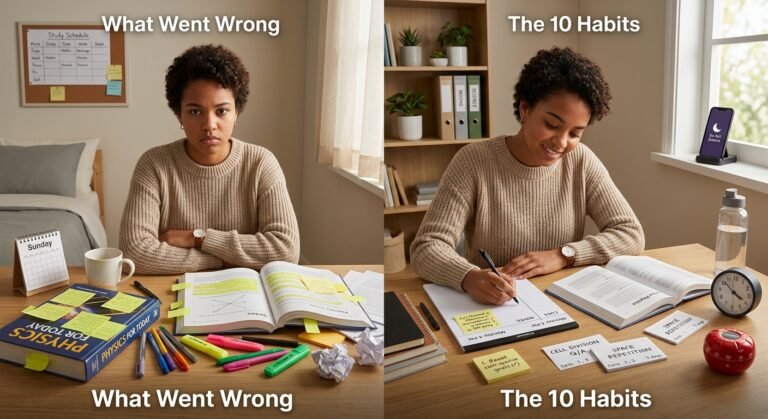
I once spent an entire Sunday “revising” for a physics test. Six hours at my desk. I had colored pens, a fresh pack of sticky notes and a very serious expression. On Monday I sat down for the paper and stared at the first question like it was written in Greek.
Six hours, and I couldn’t tell you what a vector was.
It took me years to work out what went wrong. I wasn’t lazy and I wasn’t stupid. I was just studying in a way that felt busy but didn’t do much. I’d read the chapter, highlight half of it, read it again, and call that learning. Nobody had ever told me there was a better way, and as far as I can tell, nobody tells most students.
Schools are great at handing you material. They’re oddly quiet about how to get it into your head and keep it there. So most of us wing it, and we end up with habits that feel responsible but don’t pay off.
The good news is that this stuff can be fixed, and the fixes aren’t complicated. Here are ten study habits that make a real difference. You don’t need all of them at once. Skim the table, find the one that sounds like your problem, and start there.
The 10 Habits at a Glance
| # | Habit | What it fixes | Easy first step |
|---|---|---|---|
| 1 | Set small, clear goals | Sitting down with no plan | Write 2-3 tasks on a sticky note |
| 2 | Keep a regular schedule | Panic cramming | Study at the same time each day |
| 3 | Pick a study spot | Struggling to get started | Use one place for work only |
| 4 | Cut distractions | Broken focus | Put your phone in another room |
| 5 | Test yourself | Rereading that doesn’t stick | Close the book and write what you remember |
| 6 | Space out your reviews | Forgetting within days | Review on day 1, 3 and 7 |
| 7 | Take real breaks | Brain fog | Try 25 minutes on, 5 off |
| 8 | Take better notes | Notes you can’t read later | Try the Cornell method once |
| 9 | Explain it to someone | Gaps you don’t know about | Teach a topic out loud |
| 10 | Look after yourself | Burnout | Sort out your sleep first |
1. Decide What You’re Doing Before You Sit Down
“I’ll study chemistry tonight” sounds sensible. It isn’t, really. Chemistry is enormous. You could work on it for three hours and have no clue whether you did anything useful, and since there’s no finish line, your brain sees no reason to hurry. So you tidy your desk. You answer a message. You look up a video about how pens are made.
A vague plan gives you nothing to aim at. A specific one does.
| Vague | Specific |
|---|---|
| Study history | Read pages 80-95, write five lines on why the war began, answer the three end-of-chapter questions |
| Do maths | Do 15 algebra problems, then redo the three I got wrong |
| Revise biology | Make 20 flashcards on cell division and quiz myself twice |
The second column tells you what to do and when you’re finished. That second part matters more than it sounds. Finishing something, even something small, feels good, and that feeling makes the next session easier to start.
So tonight, before you open a book, scribble two or three tasks on a scrap of paper. Make them small. Cross them off as you go. It’s a bit silly how satisfying it is.
2. Make Studying Boring and Regular
Some people study the way others go to the gym in January. Huge energy for five days, then nothing for a month. Others wait until the deadline is almost on top of them and then work like crazy for two days straight.
Neither feels great, and neither works well. Your brain likes routine. When you study at roughly the same time each day, it stops being a decision. You don’t have to talk yourself into it. You just start, the same way you’d brush your teeth without a pep talk.
Here’s what a realistic week can look like.
| Day | Time | What | Length |
|---|---|---|---|
| Monday | 4:00 p.m. | Maths, your hardest subject | 60 min |
| Tuesday | 4:00 p.m. | Science plus flashcards | 60 min |
| Wednesday | 4:00 p.m. | English reading and notes | 45 min |
| Thursday | 4:00 p.m. | Maths practice questions | 60 min |
| Friday | 4:00 p.m. | Light review of the week | 30 min |
| Saturday | 10:00 a.m. | Catch-up or past papers | 90 min |
| Sunday | Off. Actually off. |
Notice the hard stuff comes early, when you’ve still got energy. Saturday is a safety net for anything you missed. And Sunday is empty on purpose, because rest isn’t a bonus, it’s part of the plan.
Be honest about what you can keep up, too. Five hours every night looks impressive on paper and collapses by Wednesday. One steady hour a day beats it easily.
3. Find a Spot That Means “Work”
You don’t need a fancy desk or one of those perfect study setups you see online. You need a place your brain starts to link with focus.
A few basics help. Somewhere quiet enough to think. Light that doesn’t make your eyes hurt. A chair that won’t leave you squirming after twenty minutes. And everything you need close by: pens, paper, charger, water, the right textbook. Each time you get up to look for something, you give your attention permission to wander off, and it usually takes it.
I’d also say skip studying in bed. I know. It’s tempting. But after a while your brain gets muddled about whether the bed is for work or sleep, and you end up doing both badly.
If your house is loud or crowded, look elsewhere. A library works. A quiet café, an empty classroom, a relative’s spare room, all fine. The exact place matters less than going back to it. Do real work somewhere often enough and the place starts doing half the job for you.
4. Get the Phone Out of the Room
Yes, this one. You knew it was coming.
Research on attention keeps landing on the same point: a short interruption costs more than it looks like. Checking a notification takes seconds, but getting your train of thought back can take minutes. Do that ten times in an evening and your three-hour session is really about an hour of thinking, with two hours of drifting.
Willpower is a poor defense here. Those apps were built by people whose whole job is keeping you on them, and they’re good at it. It’s far easier to take the temptation away than to fight it every few minutes.
| What’s pulling you away | What to do |
|---|---|
| Phone notifications | Leave the phone in another room, or use Do Not Disturb |
| Social media tabs | Close them, or use a site blocker |
| Noise | Earplugs, or headphones with music that has no words |
| People interrupting | Tell them your study hour in advance |
| Hunger or thirst | Get a snack and water before you start |
Face-down on the desk doesn’t count, by the way. Out of sight is the goal. One properly focused hour will teach you more than three distracted ones.
5. Quiz Yourself Instead of Rereading
If you only change one thing after reading this, make it this one.
Rereading feels good. You look at the page, everything seems familiar, and your brain says, “Yep, I know this.” But recognizing something and being able to recall it are different things. It’s like watching a cooking show and then believing you could make the dish. Then exam day comes, the page isn’t there, and it all turns out to be a bit fuzzy.
Active recall means making your brain do the work. You shut the book and try to pull the information out. It’s uncomfortable, and that’s exactly why it works. Psychologists call it the testing effect, and study after study finds that students who test themselves remember more than students who reread, even when the rereaders spend more time.
| Passive (feels easy) | Active (feels harder, works better) |
|---|---|
| Rereading notes | Closing the book and writing what you remember |
| Highlighting | Turning each heading into a question and answering it |
| Copying out passages | Using flashcards |
| Rewatching a lecture | Doing practice questions and past papers |
When you draw a blank, don’t panic. A blank is useful. It tells you exactly what to study next.
6. Spread Your Studying Out
I’ll admit cramming has a certain charm. Late night, coffee, adrenaline, a dramatic escape. And it does work for a day or two.
Then it all drains away. Memory fades in a fairly predictable pattern, and without review you lose a big chunk of new material within days. The trick is to revisit things just as they start to slip. Each time you do, your brain holds on a little longer. This is called spaced repetition, and it’s among the best-supported ideas in learning research.
You can use an app like Anki if you like gadgets. A calendar with reminders works fine too.
| Review | When | How long |
|---|---|---|
| First | Within 24 hours | 10-15 min |
| Second | About 3 days later | 10 min |
| Third | About a week later | 10 min |
| Fourth | 2-3 weeks later | 5-10 min |
| After that | Monthly and before exams | 5-10 min |
What I like most is how short these sessions are. Ten minutes here and there, compared with one eight-hour panic the night before. You end up knowing the material better, and you sleep, which we’ll get to.
7. Take Real Breaks
Plenty of students believe whoever studies longest without stopping wins. It’s a nice theory. It’s also wrong.
Focus runs out. You know the feeling: you read the same sentence three times and nothing goes in. Mistakes pile up. You get snappy. A short break resets things, and your brain keeps quietly working on what you just learned while you get a glass of water.
The Pomodoro Technique is popular for good reason. It’s simple.
| Method | Work | Break | Suits |
|---|---|---|---|
| Pomodoro | 25 min | 5 min (15-30 after four rounds) | Beginners, easily distracted people |
| 50/10 | 50 min | 10 min | Essays and long problem sets |
| 90-minute blocks | 90 min | 20 min | People who already focus well |
Try one for a week and see how it feels. There’s no single right answer.
What you do on your break matters. Stand up, stretch, drink some water, look out the window, go outside for two minutes. And try to stay off your phone, because a five-minute scroll has a way of turning into twenty, and you come back more tired than you left.
8. Take Notes You Can Actually Use
Have you ever opened your own notes a week later and wondered what on earth you meant?
Most people go one of two ways. They write down everything the teacher says, word for word, or they write so little it’s worthless later. Neither works well.
Good notes catch the main ideas, the key terms, a couple of examples and how things link up. Put them in your own words, because rewording forces you to think about the idea instead of just copying it. A neat page of copied sentences looks impressive, but your brain hasn’t done much with it.
| Method | How it works | Good for |
|---|---|---|
| Cornell | Main notes on one side, a narrow column for questions, a summary at the bottom | Lectures and self-testing |
| Mind map | Central topic with branches | Subjects where ideas connect, like history or biology |
| Outline | Headings with bullet points | Quick, tidy review |
| Chart | Rows and columns comparing things | Theories, dates, formulas |
Whichever you pick, look over your notes within a day of class. Fix anything confusing, fill in gaps, and mark what you’re unsure about. That quick look counts as your first spaced review, so it does two jobs at once.
And keep your stuff organized. One folder per subject, labels you can read, a home for handouts. Hunting for a missing worksheet at 9 p.m. is a miserable way to lose study time.
9. Explain It to Someone Else
People say you don’t really understand something until you can explain it to another person. Annoyingly, it’s true.
The moment you try to teach a topic, your gaps show up. You’re halfway through, you stall, and it hits you that you’d been nodding along in class without really getting it. It’s an uncomfortable moment, but a helpful one, because now you know what to fix.
You don’t need a classroom for this. Some easy options:
- Explain it out loud to a friend, a parent, a sibling, or your reflection. Pretend they know nothing.
- Write a short explanation in plain language. If you can’t say it without jargon, you probably don’t understand it yet.
- Start a small study group and take turns teaching and asking each other questions.
A warning about groups, because I’ve seen it go wrong. They only work if everyone shows up prepared and stays on topic. Keep it small, agree on what you’re covering, and set an end time. Otherwise it turns into a hangout with a textbook sitting in the middle of the table.
Try to tackle your toughest topics early in the session, while you’re fresh, rather than saving them for when you’re running on fumes.
10. Look After Yourself
This isn’t really a study habit, but I’d argue everything else rests on it.
You can’t out-study bad sleep. While you sleep, your brain sorts what you’ve learned and strengthens the connections. Staying up till 3 a.m. to squeeze in extra revision is a lousy trade. You’ll be foggy, forgetful and much more likely to make silly mistakes.
| Area | Why it matters | A simple target |
|---|---|---|
| Sleep | Your brain stores memories while you rest | Around 7-9 hours, at regular times |
| Food | Steady energy helps you think | Real meals, not skipped ones |
| Water | Even mild dehydration hurts concentration | A bottle on your desk |
| Movement | Lifts your mood and wakes you up | A daily walk or short workout |
| Downtime | Prevents burnout | Friends, hobbies, doing nothing |
I want to say one more thing plainly. Some stress around exams is normal. But if you feel anxious or low most of the time, and it’s getting in the way of studying, sleeping or enjoying anything, please don’t just grit your teeth and push on by yourself. Talk to a teacher, a school counselor, a family member or a friend you trust. Asking for help isn’t weakness. It’s one of the smartest moves you can make.
So Where Should You Start?
Ten habits is a lot. My honest advice is not to try them all at once. That’s how people change everything for a week and quit on day eight.
Pick two or three that match your biggest problems.
| If you… | Start with… |
|---|---|
| Get distracted constantly | Habits 3 and 4 (study spot, phone away) |
| Cram before every exam | Habits 2 and 6 (schedule, spaced reviews) |
| Study hard but forget it all | Habits 5 and 9 (self-testing, teaching) |
| Feel exhausted and burnt out | Habits 7 and 10 (breaks, sleep and wellbeing) |
| Have messy notes | Habit 8 (try Cornell for a week) |
Stick with those for two or three weeks, until they feel normal, then add another. Slow and a bit boring beats big and dramatic nearly every time.
Go easy on yourself, too. You’ll skip a session. You’ll get distracted. On a bad day you’ll slide back into old habits. Everyone does. What counts is the next day, when you simply pick it up again.
Final Thoughts
Good grades don’t only go to the naturally brilliant kids. More often they go to the people who figured out how to learn. They know what they’re doing before they start, they show up regularly, they test themselves, they review over time, they guard their focus and they look after themselves.
And none of it stays at school. The focus and self-discipline you build now will help you at university, at work, and any time life hands you something new to figure out, which happens more than you’d think.
So here’s a small challenge. Forget the all-nighter. Pick one habit from this list and try it tonight. Put your phone in another room, write down one clear goal, or close your book and see how much of the last page you can remember. It might feel awkward at first. Give it a couple of weeks and see what happens. I think you’ll be surprised.
