


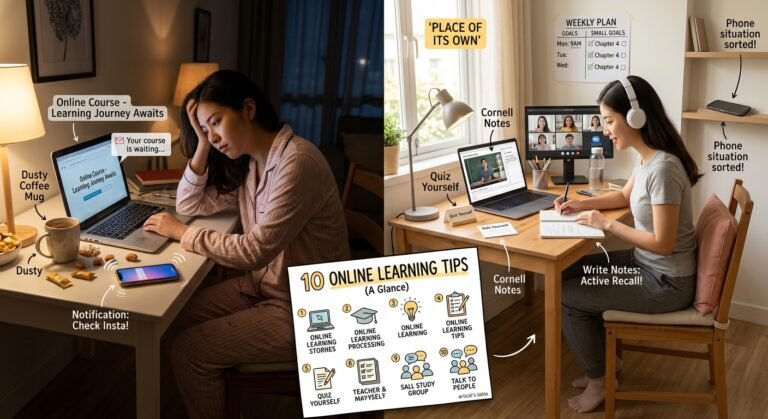
Okay, so my first online course. I bought it at about 11 at night, which tells you everything. Late-night me is always very ambitious. I watched one video, felt like a genius, and went to bed.
Then nothing. For a whole month. The only reason I opened it again was an email saying my “learning journey” was waiting. It wasn’t. It was sitting there collecting dust, and so was I.
What took me far too long to figure out is that online learning isn’t really hard because of the subject. It’s hard because there’s nobody around. No teacher giving you the look when you walk in late. No friend next to you groaning about the same assignment. Just you, a laptop, and a phone that’s way more interesting than anything on your screen.
So these are the “Ten Online Learning Tips” I wish somebody had sat me down and told me. A few come from my own disasters, a few from watching friends go through the same stuff. None of it costs money, and none of it needs an app (although I’ll mention one or two).
The 10 Tips at a Glance
| # | Tip | Why Bother |
|---|---|---|
| 1 | Pick one spot for studying | Your brain gets the message faster |
| 2 | Plan a week you can really live | No more daily arguing with yourself |
| 3 | Make goals tiny and clear | You actually finish things |
| 4 | Write notes in your own words | You understand, not just copy |
| 5 | Sort out your phone situation | Real focus, finally |
| 6 | Quiz yourself, stop rereading | It stays in your head |
| 7 | Talk to people | Less lonely, learn more |
| 8 | Take proper breaks | Dodge burnout |
| 9 | Look after your body | Better memory and mood |
| 10 | Do a quick weekly check-in | Get better as you go |
1. Give Studying a Place of Its Own
Nobody needs a fancy desk. I studied at a wobbly table by the window for a whole year and it was fine. What matters is that the spot means one thing: work.
I used to study in bed. Lovely idea, terrible result. My body heard “lying down” and decided it was nap time. More than once I woke up with a highlighter lid stuck to my cheek. The sofa wasn’t any better, because the TV was right there looking at me.
So choose a corner, even a small one, and stock it. Charger, notebook, pens, a bottle of water. If you have to go hunting for a pen every time you sit down, that’s ten minutes gone and your mood is already worse. And if you share a room with family, headphones are basically a portable door. Use them.
| What You Need | Why It Matters | Cheap Fix |
|---|---|---|
| Decent light | Dim rooms make you sleepy | A desk lamp, or sit near a window |
| A chair that doesn’t hurt | Back pain wrecks focus | Put a cushion on it |
| Not too much noise | Hard to think otherwise | Headphones, soft background music |
| A mostly clear surface | Clutter distracts you more than you’d guess | Push away everything you’re not using |
| Steady internet | Frozen lectures are miserable | Sit closer to the router |
When you sit there, you study. When you’re done, you get up and leave. Sounds a bit silly. Works anyway.
2. Plan a Week You Can Really Live
Every Sunday night I’d build the perfect timetable. Colors, labels, six hours of study every single day. It was a work of art. By Tuesday afternoon it was dead.
The problem was that I’d planned for some other person, one who doesn’t work, doesn’t cook, doesn’t get tired, and never has a bad day.
So start with your real week. What’s already taking up your time? Then ask yourself when your brain works best. Some people are sharp at 6 in the morning. Others don’t properly wake up until night. Neither is wrong. Put your toughest subject in your best hours and keep the easy stuff, like tidying notes, for when you’re drained.
Try blocks of 45 to 90 minutes with gaps in between. A packed schedule with zero breathing room is just a guilt machine.
| Day | Morning | Afternoon | Evening |
|---|---|---|---|
| Mon | Live class | Assignment | Light review |
| Tue | Reading | Errands, free time | Practice questions |
| Wed | Live class | Group work | Rest |
| Thu | Hardest subject | Clean up notes | Light review |
| Fri | Quiz prep | Hand in work | Free |
| Sat/Sun | Catch up if needed | Rest | Plan next week |
And treat those blocks like real appointments. You wouldn’t blow off the dentist for no reason. Same rule.
3. Make Goals So Small They’re Almost Embarrassing
“Study chemistry” is not a goal. It’s a vibe.
“Read chapter 4 and do the ten practice questions by 5 p.m.” is a goal. You know when you’re finished, and ticking it off feels surprisingly good. I’m not joking, I have a little checklist and I get weirdly happy crossing things out.
The big goals still matter. Passing the course, finishing the degree, all that. But they’re far too distant to drag you off the couch on a grey Wednesday. Chop them up: semester, month, week, day. It’s the daily ones that do the real work.
Here’s a small trick that saved me loads of time. At the end of each session, write down the very first thing you’ll do next time. Then when you come back, you don’t sit there wondering where you were. You just start. That “where do I begin” moment is exactly where procrastination slips in.
4. Write Notes in Your Own Words
When I started out, I wrote down everything the instructor said. Everything. My notes looked amazing and I remembered nothing, because the words were traveling from the screen to my hand without ever stopping in my head.
Try this instead. Listen for a few minutes, pause, and write what you understood in your own words. If you can’t explain it simply, you haven’t got it yet. Annoying to find out, sure, but much better now than the night before the exam.
There’s research suggesting handwriting helps people remember more than fast typing, partly because you can’t write everything and have to pick what matters. Still, if typing suits you better, type. Just don’t turn into a photocopier.
| Method | Good For | Watch Out For |
|---|---|---|
| Cornell notes | Lectures, textbooks | Takes a bit of setup |
| Mind maps | Seeing how ideas link up | Gets messy quickly |
| Outlines | Neat, structured subjects | Easy to slide into copying |
| Question-style notes | Exam prep | Needs more thinking at first |
| Note apps | Searching, organizing | Notifications pull you away |
Try a couple, keep what feels natural. Nobody gives out medals for the “right” system.
5. Sort Out Your Phone Situation
Let’s just say it. The phone is public enemy number one.
It sits right there, glowing, buzzing, whispering “just check one thing.” And the check itself isn’t the real cost. It’s the time your brain needs to get back into the topic afterwards. Do that ten or twelve times in an hour and you’ve been at your desk for sixty minutes but studied for maybe twenty. I’ve done the math on my own bad days and it hurts.
What actually helped me:
- Phone goes in another room, or at least face down on silent
- Close every tab that has nothing to do with class
- Use a site blocker during study time
- Turn off email and chat pings on the laptop
- Don’t open social media on the device you study on
If an hour without your phone sounds impossible, try the Pomodoro method. Work for 25 minutes, break for 5. Twenty-five minutes is short enough that you can’t really argue with it, and a lot of the time you just keep going when the timer rings.
6. Quiz Yourself Instead of Rereading
If you only take one tip from this whole thing, take this one.
Most of us study by rereading. We go over the notes again, and again, and because everything looks familiar, we think we know it. It’s a sneaky feeling. Then you sit in the exam, look at a blank page, and it all vanishes.
Active recall is the fix. Close the book and ask yourself what you remember. Write it down or say it out loud. Flashcards, practice questions, explaining the topic to your cat, all of it counts. It feels harder than rereading, and that’s exactly why it works.
Spaced repetition just means coming back to something after a gap. Today, then in two days, then a week later, then a month. Your brain holds onto the stuff it has to struggle to pull back up.
| Technique | What You Do | Why It Helps |
|---|---|---|
| Active recall | Quiz yourself with notes closed | Builds stronger memory |
| Spaced repetition | Review at longer and longer gaps | Slows down forgetting |
| Explain it simply | Teach it in plain words | Shows you what you don’t understand |
| Past papers | Practice with a timer | Builds exam confidence |
| Rereading | Look at notes again | Feels nice, works badly |
Flashcard apps will handle the scheduling for you. Paper cards work just as well if that’s your style.
7. Talk to People
Online study gets lonely in a way that sneaks up on you. You can go a whole week without one real conversation about your subject, and then wonder why everything feels a bit flat.
So join in. Ask the question in the chat, even if it feels basic, because somebody else is wondering the same thing. Post on the discussion board even if you’re not sure you’re right. Being a little wrong in public is how most of us learn anything. If you’re stuck, email your instructor early instead of suffering quietly for a week.
Even better, find a study buddy or a small group. A weekly call where everyone explains one topic to the rest is surprisingly powerful. Explaining something is the quickest way to find out which parts you only half understand.
And please don’t vanish. A lot of online instructors say the silent students are the ones they worry about most, because they have no idea who’s struggling.
8. Take Real Breaks
Switching from your laptop to your phone is not a break. You’ve changed screens, that’s all. Your brain is still taking things in.
A real break means getting up. Stretch, look out the window, make a snack, talk to someone at home, stand outside for a few minutes. Let your mind wander. I can’t tell you how often the answer to a stubborn problem has shown up while I was washing a cup.
Marathon sessions feel heroic, but your attention drops off after an hour or so. Two focused hours with proper breaks usually beat five foggy ones.
| Break Length | Good Choices | Skip These |
|---|---|---|
| 5 minutes | Stretch, water, slow breaths | Scrolling social media |
| 15 minutes | Short walk, quick chat, snack | Starting a new episode |
| 30+ minutes | A proper meal, fresh air, light exercise | Skipping the break entirely |
9. Look After Your Body
Your brain lives inside your body. Obvious, yes, but when deadlines pile up, sleep and food are the first things to go.
Sleep matters most. Pulling an all-nighter before an exam usually backfires, since your brain does a lot of its memory sorting while you sleep. Try to keep a steady bedtime and put screens away for the last half hour of your day if you can.
Drink water. Eat actual meals, not only biscuits and tea (guilty). Move a bit every day, even a 20-minute walk, because it helps both mood and focus. And if you feel overwhelmed or anxious for a long stretch, talk to someone. A friend, family, a counselor, or your school’s student support team. Asking for help isn’t weakness. It’s just sensible.
| Habit | Aim For | What It Does for Studying |
|---|---|---|
| Sleep | Around 7 to 9 hours | Better memory, sharper focus |
| Water | Sips through the day | Fewer headaches |
| Movement | A short walk or stretch daily | Lifts mood, clears your head |
| Meals | Regular and reasonably balanced | Steadier energy |
| Eye breaks | Look away from the screen every 20 minutes or so | Less strain |
10. Do a Quick Weekly Check-In
Once a week, give yourself ten minutes. Sunday works, but any day is fine. Ask three things:
- What went well?
- What got in my way?
- What am I changing next week?
Maybe you notice you focus much better in the morning. Maybe the study group helped a lot. Maybe your phone won again, it happens. Whatever you find, use it. You don’t need the perfect system on day one. You just keep noticing what works for you and slowly drop what doesn’t.
And celebrate the small stuff. Finished a tough module? Treat yourself. Handed something in early? Take the evening off. If you never acknowledge progress, the whole thing starts to feel like a treadmill.
Common Mistakes (and What to Do Instead)
| Mistake | What It Looks Like | Try This |
|---|---|---|
| Waiting to feel motivated | “I’ll start when I’m in the mood” | Commit to five minutes; momentum often follows |
| Binge-watching lectures | Eight videos, nothing remembered | Pause and summarize after each one |
| Studying with no plan | Hopping from topic to topic | Pick your goal before opening anything |
| Going it alone | Weeks without asking for help | Reach out early |
| Leaving it all until the deadline | Panic and rushed work | Set your own earlier deadlines |
Final Thoughts
Online learning hands you a lot of control over your own education. That’s a gift, but it also means nobody is going to build your habits for you.
You don’t have to do all ten tomorrow. That’s a fast route to burnout by Thursday, trust me. Pick two or three that feel doable. A study spot, a simple weekly plan, and your phone in another room is a really good start. Give it a couple of weeks, then add more.
Some days will be a mess. You’ll skip a session, fall behind, or stare at the screen wondering why you signed up at all. Everyone does. What counts is coming back the next day and opening the lesson again.
Honestly, that’s the whole secret. Not talent, not a perfect routine. Just coming back.
So pick one tip and try it today. Even a small one.
