


I want to start with a small confession. Most vocabulary building lessons I’ve seen, and a lot of the ones I sat through as a kid, follow the same script. Ten words on the board. Copy the definitions. Move on.
And it kind of works, for about four days.
Then a week later you use one of those words in class, something like “reluctant” or “significant,” and the room goes quiet. Not because anyone’s being difficult. The words just never had a chance. They showed up once, in a list, with a definition nobody really thought about, and the brain did what brains do with stuff that doesn’t seem to matter. It let go.
So this isn’t an article about better lists. It’s about 15 things you can do with words so they stay put. Some take two minutes. Some take a whole lesson. A few are slightly silly, and I’d argue those are the best ones.
First, why it’s worth caring about
Vocabulary has a snowball effect. Kids who know a lot of words find reading easier, so they read more, so they pick up even more words. Kids who know fewer words find reading tiring, so they avoid it, and the distance between the two groups grows every year. Researchers call this the Matthew effect. It sounds fancy, but it just means the word-rich keep getting richer.
It also isn’t only an English problem. Plenty of kids who seem “bad at science” are actually stuck on words like hypothesis and variable. Plenty who struggle in history have never properly met treaty or reform. Fix the words and sometimes the subject suddenly gets easier.
What we’re after, then, isn’t a longer list. It’s a shorter one that kids genuinely know.
What makes a word stick (the short version)
You don’t need a degree in psychology. Here’s roughly what the research keeps saying, translated into classroom terms.
| The idea | What it means | What you might do |
|---|---|---|
| Lots of exposure | One meeting is useless. Most kids need a word 8 to 12 times, sometimes more | Bring words back in other lessons |
| Using it | Producing a word beats reading it | Make them say it, write it, act it |
| Real context | A word inside a story makes more sense than a word in a list | Pull words from what they’re already reading |
| Different senses | Pictures, movement and sound all give the memory more hooks | Draw it, mime it, argue about it |
| Spacing | Short and often beats long and once | Quick reviews over the following days and weeks |
| Word parts | Knowing roots helps with words you’ve never seen | Teach a few prefixes and suffixes |
Every activity below leans on at least two of those. Okay, on to them.
Reading activities
Most new words come from reading, but kids are brilliant at gliding right past the hard ones. These slow them down in a good way.
1. Word hunt journals
Give each student a small notebook. Whenever they hit a word that’s new, interesting or just strange, they jot it down like this:
| Column | What they write |
|---|---|
| The word | And the sentence they found it in |
| My guess | What they think it means before looking it up |
| The real meaning | Checked afterwards |
| My own sentence | Something they invented |
The guess column matters more than it looks. Even a wrong guess gets the brain curious, so the right answer sticks better. And some of the wrong guesses are lovely. I once heard “ominous” defined as “kind of like a lot of omens, like, bunch of them.” Not wrong, exactly.
2. Context clue detectives
Choose a short passage with a few tricky words and tell the class they’re detectives. The job is to work out what a word means from the sentences around it, no dictionary allowed.
Teach the common clue types first:
| Clue type | What to look for | Example |
|---|---|---|
| Definition | The writer just tells you | “A nomad, someone who moves from place to place, …” |
| Synonym | A similar word nearby | “She was elated, truly overjoyed.” |
| Antonym | A word with the opposite meaning | “Unlike his frugal brother, he spent freely.” |
| Example | A list that shows the idea | “He loved citrus fruits like lemons and limes.” |
| Inference | You piece it together | “The drought cracked the fields. No rain for months.” |
If you want to add some theatre, cover the target word with a sticky note. Let everyone guess what’s underneath. Then peel it off. Kids love a reveal more than you’d expect.
3. Word Wow moments
When you read aloud, stop at a good word. Say it again, explain it in everyday language, use it in a different sentence, and ask the class to give a silent thumbs-up if they spot it again later. Put your favourites on a “Word Wow” wall.
Little ones love this. Teenagers act like they don’t, and then you’ll catch one giving a sneaky thumbs-up from the back row.
Games
Some teachers feel faintly guilty about games, as if they’re skipping the “real” work. Don’t. A game makes students pull a word out of memory again and again, and that pulling is the thing that builds memory. The fun is just how you get them to do it willingly.
| Game | How it works | Why it helps |
|---|---|---|
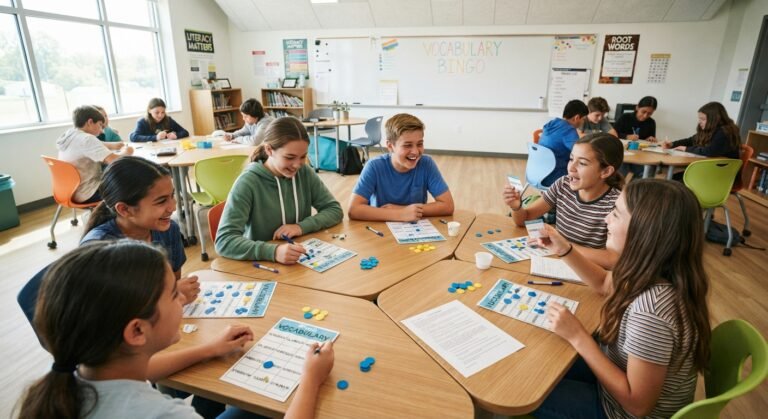
| 4. Vocabulary bingo | Students fill a 5×5 grid with unit words. You read definitions or sentences, they mark the match | They have to listen properly and recall quickly |
| 5. Charades or Pictionary | One student acts or draws the word, teammates guess | They have to think about what the word actually means |
| 6. Word association chains | You say “journey,” next person says “map,” next says “explore.” Each link gets explained | It builds the web of connections words live in |
| 7. Taboo-style describing | Get your team to say the word without using it or a few banned words | They’re forced to find synonyms and examples on the spot |
A few things I’d pass on. With older kids, make bingo harder by reading sentences with a gap in them: “The sudden storm made the picnic ______.” For Taboo, write your own cards from your current unit so the game works as revision too. And in charades, don’t steer around the abstract words. “Jubilant” is much harder to mime than “wander,” which is exactly why it’s worth trying. It’s also usually the funniest round.
Writing and speaking activities
A word isn’t really yours until you can use it without someone holding your hand. These push students from “I recognise that” to “I can say that.”
8. Sentence upgrades
Write something flat on the board: The man was angry and walked out of the room.
Now ask the class to improve it with words from your unit. The furious man stormed out of the room. Then talk about it. Is “furious” stronger than “irritated”? Is “livid” too much? Kids end up having proper arguments about shades of meaning, which is where real vocabulary growth lives.
9. Mini stories with must-use words
Hand out five to eight target words and ask for a short story, even a single paragraph, that uses all of them naturally. Then swap with a partner, who highlights each word and decides if it was used correctly. This catches loads of near misses, like someone writing “enormity” when they mean “enormous.” Plenty of adults do that too, so no one needs to feel bad.
10. Two-minute talks
Each student picks a word and talks about it for two minutes: what it means, when you’d use it, maybe a quick story. If a student is nervous, let them use notes or talk to a small group rather than the whole class. Speaking makes you retrieve a word fast, and fast retrieval is worth more than a third read-through of the same page.
Visual and creative activities
Some kids forget a definition by lunchtime but remember a daft drawing for years. Let’s make use of that.
11. Frayer charts
Students divide a page into four boxes around a central word. It’s an old classic for good reason.
| Box | What goes in it |
|---|---|
| Definition | In their own words, not copied |
| Characteristics | What’s true about it |
| Examples | Things that fit |
| Non-examples | Things that don’t fit |
The non-examples box is the clever bit. Working out what a word isn’t sharpens your sense of what it is.
12. Word maps and vocabulary comics
Ask students to map a word: meaning, synonyms, opposites, a little picture, a sentence. Or go sillier and have them draw a three-panel comic where the word is the whole joke. Stick figures are completely fine. The point isn’t art. The point is turning a word into a tiny scene, which makes it much harder to lose.
13. Word roots workshop
Teach a handful of useful word parts, then let students go exploring.
| Word part | Meaning | Words it unlocks |
|---|---|---|
| bio | life | biology, biography, biodegradable |
| geo | earth | geography, geology, geometry |
| port | carry | transport, portable, export |
| un- | not | unfair, unbelievable, unlock |
| -able | can be done | readable, portable, breakable |
When students start seeing words as Lego bricks instead of solid blocks, they can crack unfamiliar ones on their own. When it clicks for a kid, it’s one of the nicest things you’ll see all week.
Tech that’s actually useful
14. Digital flashcards with spaced repetition
Apps like Quizlet and Anki show each card just before you’d forget it, which happens to be the best moment to review. One tip: let students build their own cards, with a sentence and a picture. Making the card is half the learning, and it feels more theirs than a ready-made deck.
15. A shared class word wall
Set up a shared document, or use an actual wall, where students add words they’ve come across. Give it three columns: the word, where they found it, and their own example. Over a term, it becomes a living dictionary the whole class built together. Kids get weirdly proud of adding a good one.
Which activity when?
If you’re tired and short on time, scan this and pick one.
| Activity | Best for | Time | Prep |
|---|---|---|---|
| Word hunt journals | Independent readers | 5 to 10 min daily | Low |
| Context clue detectives | Grade 3 and up | 15 to 20 min | Medium |
| Word Wow moments | Younger or mixed classes | 5 to 10 min | Low |
| Vocabulary bingo | Revision before a test | 10 to 15 min | Medium |
| Charades or Pictionary | Wriggly, energetic groups | 15 to 20 min | Low |
| Word association chains | Warm-ups, spare minutes | 5 to 10 min | Almost none |
| Taboo-style describing | Middle and high school | 15 to 20 min | Medium |
| Sentence upgrades | Writing practice | 10 to 15 min | Low |
| Mini stories | Creative writers | 20 to 30 min | Low |
| Two-minute talks | Building confidence | 20 to 30 min | Low |
| Frayer charts | Tricky, abstract words | 15 to 20 min | Low |
| Word maps and comics | Visual learners | 20 to 30 min | Low |
| Word roots workshop | Upper primary and up | 20 to 30 min | Medium |
| Digital flashcards | Self-paced review | 5 to 10 min daily | Medium |
| Shared word wall | Class culture | Ongoing | Low |
A weekly pattern you can borrow
One-off activities are nice. A rhythm is better. Here’s a simple week that covers eight to ten words without anybody drowning.
| Day | Goal | Try this | Time |
|---|---|---|---|
| Monday | Meet the words | Read-aloud, plain-English definitions, Frayer chart for two key words | 20 min |
| Tuesday | Understand them | Context clue detectives and word maps | 20 min |
| Wednesday | Use them | Sentence upgrades or mini stories | 20 min |
| Thursday | Play with them | Bingo, Taboo or charades | 15 min |
| Friday | Check and recycle | Short quiz plus two-minute talks | 15 min |
The part people skip is what comes after Friday. Words from earlier weeks need to keep creeping back in, through warm-ups, exit tickets, or a five-minute “old words” slot on Monday mornings. That small habit does more than almost any quiz.
Adjusting for different ages
The ideas stay the same, but how you dress them changes.
| Age group | What tends to work | Keep in mind |
|---|---|---|
| 5 to 8 | Read-alouds, picture cards, acting, songs | Short, physical, everyday words |
| 9 to 11 | Journals, bingo, simple roots, context clues | Start comparing similar words |
| 12 to 14 | Taboo, mini stories, Frayer charts, flashcards | Pairs and teams keep them engaged |
| 15 to 18 | Roots, academic word lists, debate, sentence upgrades | Link words to exams and essays |
| English learners | Visuals, glossaries, sentence frames, cognates | Start with common and academic words |
Mistakes almost everybody makes
I’m not pointing fingers. These are easy traps, and most of us have walked into every one.
| Mistake | Why it backfires | Try this instead |
|---|---|---|
| Twenty words a week | Students hold on to a handful at best | Pick 5 to 10 and teach them well |
| Definitions only | A dictionary entry doesn’t show how a word behaves | Add examples, non-examples and sentences |
| No review | Words fade if nobody revisits them | Build recycling into the routine |
| Rare, fancy words | Great for the list, little use in real life | Choose “Tier 2” words kids will meet often, like analyse, contrast, significant |
| Vocab as a separate box | Words stay stuck in one lesson | Weave them into reading, writing and other subjects |
How do you know it’s working?
Quizzes tell you about short-term memory and not much else. A mix of methods gives a truer picture.
| Method | What it shows | How often |
|---|---|---|
| Matching or multiple choice | Basic recognition | Weekly |
| Fill-in-the-blank | Can they choose the right word in context? | Weekly or fortnightly |
| Original sentences | Can they use it correctly? | Fortnightly |
| Spoken explanation | How deep is the understanding? | Monthly |
| Delayed review quiz | Long-term memory | Every few weeks |
| Writing samples | Do new words turn up unprompted? | Once a term |
But the best evidence won’t be on any chart. It’s the day a student slips “reluctant” into a conversation about something unrelated, or corrects a friend who said “enormity” when they meant “enormous.” That’s the moment a word leaves the list and joins real life. Enjoy it when it happens.
A few small habits that help
- Start small. Pick two or three activities and repeat them until they feel automatic. Trying all 15 in a month is a fast route to burnout.
- Let students choose some words. People care more about words they picked.
- Say when you don’t know a word. Look it up in front of the class. It shows that grown-ups still do this.
- Use the words yourself. Slip them into your instructions and feedback: “That was a nicely concise summary.”
- Keep home practice light. Parents can play word games in the car or talk about new words over dinner. No worksheets needed.
Quick answers
| Question | Short answer |
|---|---|
| How many new words a week? | Five to ten well-chosen words for most classes. Fewer, with more pictures, for English learners |
| Are word lists still useful? | Yes, as a starting point. The trouble is what happens after kids receive the list |
| What’s the best single activity? | There isn’t one, but a word journal plus regular review goes a long way |
| How can I help struggling readers? | Pre-teach key words, use pictures and gestures, keep practice short, and celebrate small wins |
Last thoughts
Building vocabulary isn’t about cramming in more words. It’s about giving students lots of chances to meet words, play with them, argue about them, and use them in sentences that mean something to them. When that happens, vocabulary stops being a Friday-quiz chore and turns into a habit of noticing language.
So pick two or three of these vocabulary building activities for students and try them for a few weeks. Then keep your ears open. One day a word you taught will turn up somewhere you didn’t expect, and that little moment is the best feedback you’ll ever get.
