


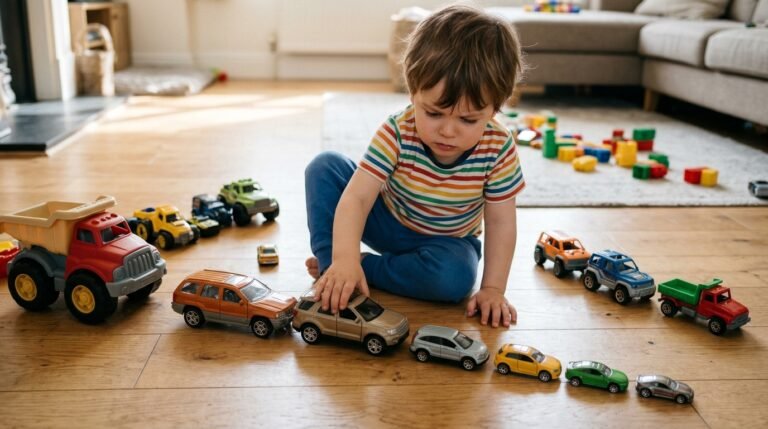
Try asking a four year old to “do some maths” and watch their face. Now ask the same child to split a biscuit so it’s fair, and they’ll inspect both halves like a diamond cutter.
Small children are doing maths all day. They count the stairs. They tell you, loudly, that their sister got more peas. They line up their cars from biggest to smallest and get cross if you move one. We just don’t call it maths, so we miss it.
Early Maths Activities List
This list is about catching those moments and nudging them along a little. Nothing here needs a printer or a shopping trip. You’ll find socks, spoons, a pack of cards and a bag of pasta, and the ideas suit roughly ages 3 to 7. Some will flop with your child and be a huge hit with the next one. That’s fine. Drop the flops and try something else tomorrow.
The Whole List at a Glance
Skim this first and pick whatever suits the mood and the clock.
| # | Activity | What it builds | Good for ages | Rough time |
|---|---|---|---|---|
| 1 | Count the stairs | Counting, one number per object | 2–5 | 2 mins |
| 2 | Sock sorting | Sorting, spotting differences | 3–6 | 10 mins |
| 3 | Baking | Measuring, halves, doubling | 4–7 | 30+ mins |
| 4 | Number treasure hunt | Knowing the order of numbers | 3–6 | 15 mins |
| 5 | Blocks and boxes | Shapes, size, early adding | 3–7 | 15 mins |
| 6 | Board games | Counting on, dice patterns | 4–7 | 20 mins |
| 7 | Shape hunt | Naming and spotting shapes | 3–6 | 10 mins |
| 8 | Dinner table maths | Sharing, more and fewer | 4–7 | 5 mins |
| 9 | Making patterns | Predicting what comes next | 3–7 | 10 mins |
| 10 | Water and sand play | Capacity, full and empty | 2–6 | 20 mins |
| 11 | Number songs | Counting forwards and back | 2–5 | 5 mins |
| 12 | Play shop | Coins, adding, taking away | 4–7 | 20 mins |
| 13 | Measure everything | Length, comparing | 4–7 | 15 mins |
| 14 | Cards and dice | Number bonds, quick recognition | 5–7 | 10 mins |
| 15 | Telling the time | Clocks and daily routine | 5–7 | 5 mins |
1. Count the Stairs
Free, instant, and you’re probably heading up the stairs anyway.
Count each step out loud together. At first your child will probably chant the numbers like a nursery rhyme without really matching them to the steps. Let them. Eventually the penny drops that one number goes with one step, and that tiny idea sits underneath all later counting.
When they’ve got it, go down backwards from ten. Or climb in twos and see who gets out of breath first. Asking “how many do you reckon there are?” before you start is a nice touch too. Wrong guesses are half the fun.
2. Sock Sorting
Every house has a basket of clean socks that nobody wants to deal with. Tip it onto the floor and recruit a helper.
Matching pairs comes first, and it’s harder than it looks when half the socks are grey. After that, try piles by colour, by size or by whose feet they belong to. Ask “why did you put that one there?” because the answers can be brilliant. One child might sort by stripes while another sorts by “feels fluffy”, and both are doing real mathematical thinking.
3. Baking Together
It’s messy, it takes twice as long as doing it yourself, and it’s wonderful for maths.
Pancakes or plain biscuits are about right. Your child counts the eggs, scoops and levels the flour, watches the timer and spots when the scale hits the right number. Words like half, full, empty and double show up on their own. If the recipe says three scoops, they count three scoops. Want a bigger batch? Congratulations, you’ve just taught doubling, and there’s a snack at the end.
4. Number Treasure Hunt
Write the numbers 1 to 10 on scraps of paper and hide them around the room or garden. Your child hunts them down, then lays them out in order. For younger ones, just do 1 to 5.
Once they’ve got the knack, throw in a few questions. Which number comes after 6? Can you find the one that’s a bit smaller than 9? Running around helps more than you might expect, because many kids think better when their legs are moving.
5. Blocks and Boxes
Building toys are sneaky maths toys. Stacking teaches height and balance. Sorting recycling into big, middle-sized and small is comparing. When your child announces “I need one more to make it the same”, that’s addition, said out loud, with no sums in sight.
Sit down and join in with easy questions. Which tower is taller? How many bricks are in it? What happens if we take two off? Real objects are great for shape names too. A cereal box is a cuboid, a tin of beans is a cylinder, a ball is a sphere. Kids hold onto those far better than pictures in a book.
6. Board Games
Any game with a dice and a path will do: snakes and ladders, Ludo, whatever’s lurking at the back of the cupboard. Children count spaces, read dice, and practise waiting for their turn, which might be the hardest maths-adjacent skill of all.
Something good happens over time. They stop counting every dot and just know that pattern means four. That’s called subitising, a posh word for seeing a number at a glance, and it helps with mental sums later. No board games to hand? Draw a wiggly path on a sheet of card, number the squares and let your child decorate it. They’ll defend a game they made like it’s the Premier League.
7. Shape Hunt
Send your child off as a shape detective. Mission: three circles, two rectangles, one triangle. Plates, clocks, windows and books will cover most of it. Triangles can be stubborn, so you might have to point out a roof tile or a sandwich cut corner to corner.
When they’re good at this, ask trickier things. Can you find something with four corners? Something with a curved edge? Take the hunt on a walk too. Road signs, flower petals and brick walls are everywhere once you start looking.
8. Dinner Table Maths
Ask your child to lay the table. How many forks do we need? Two of us are out tonight, so how many fewer? Grandad’s popping round, so how many more?
Food is also a painless way into fractions. Cut a sandwich in half and talk about it, then cut those halves in half. If we cut it into four, how many pieces does everyone get? Children care deeply about fair shares, so they tend to be very motivated to get the answer right.
9. Making Patterns
Patterns teach children to predict what’s coming, and that habit matters a lot in maths. Grab buttons, pasta shapes or coloured pencils. Start with red, blue, red, blue and ask what comes next.
When that’s easy, try red, red, blue, red, red, blue. Then swap over and let them make one for you to finish. Being the teacher is a big thrill. If you want something to keep, thread pasta tubes or beads onto string for a pattern necklace.
10. Water and Sand Play
Measuring is a slippery idea on paper, but it makes sense straight away in the bath or a washing-up bowl. Hand over some cups, jugs and spoons in different sizes, and let the pouring begin.
Ask as they go. How many small cups fill the big jug? Which one holds more? Is it full, half full or empty? Don’t fuss about exact numbers. You’re building a feel for volume and picking up useful words like equal and capacity as you chat. Put a towel down first.
11. Number Songs and Rhymes
“Five Little Ducks”, “Ten in the Bed” and “Five Currant Buns” have been teaching counting for generations, and they do it well. They go forwards, they go backwards, and they slip in subtraction without anyone noticing.
Bring props. Toy ducks, fingers or paper cut-outs all work, and removing one each verse lets your child see the number shrink. You’ll sing it about fifty times. Every round strengthens their number order, so grit your teeth and carry on.
12. Play Shop
Stick prices on tins, toys or bananas and hand out real or pretend coins. Take turns being the shopkeeper and the customer. Your child practises reading numbers, counting coins and understanding that things cost something.
Keep prices tiny at the start, 1p or 2p. Later try: “I’ve got five coins and this costs three, so how many will I have left?” Swapping roles is handy because they have to work out the sum from both sides of the counter. Fair warning, some shopkeepers get very strict about prices.
13. Measure Everything
Give your child a ruler, tape measure or even a bit of string and officially appoint them Chief Measurer. How long is the sofa? How wide is the front door? Whose foot is the longest in the house?
For little ones, use their own body. Hand spans, footsteps and thumb widths all work. When their sofa is six hand spans and yours is four, you’ve got a perfect chance to explain why people invented rulers. That “ohhh, I get it” moment is worth waiting for.
14. Cards and Dice
A pack of playing cards costs almost nothing and does an enormous amount. Take out the picture cards and keep the numbers 1 to 10. Snap and Higher or Lower are easy first games.
For a step up, try Make Ten. Spread out some cards and hunt for pairs that add up to ten. This builds number bonds, which make adding and subtracting much quicker later on. If your child counts on their fingers, let them. It’s a perfectly good strategy and plenty of adults still do it.
15. Telling the Time
Clocks are hard, so go slowly and tie them to real life. Mention the hour hand at lunchtime or bedtime. Make a paper plate clock with hands that move, and let your child set it to story time.
Stick with o’clock and half past for ages. Quarter past and quarter to can wait. Time is invisible to young children, so link it to things they can feel. Can you hop ten times before the timer goes off?
Making Each One Easier or Harder
Children change from day to day, so it helps to know how to adjust on the spot.
| Activity | Too tricky? | Too easy? |
|---|---|---|
| Count the stairs | Count the first five only | Count in twos, or backwards |
| Sock sorting | Just two piles | Sort by colour and size together |
| Treasure hunt | Numbers 1 to 5, in order | Go up to 20, hidden in a muddle |
| Making patterns | Two things repeating (red, blue) | Three things, or patterns that grow |
| Play shop | Everything costs 1p | Work out change from 10p |
| Cards | Use cards 1 to 5 | Add three cards together |
| Telling the time | O’clock only | Quarter past, quarter to, five-minute jumps |
Little Maths Words to Slip into Chat
You don’t need a script. Just let a few of these pop up in normal conversation and they’ll soak in.
| Idea | Try saying | Like this |
|---|---|---|
| Comparing | more, fewer, bigger, smaller | “You’ve got more grapes than me!” |
| Measuring | longer, shorter, heavier, lighter | “Which bag is heavier to carry?” |
| Position | above, below, between, next to | “Your ball is between the two chairs.” |
| Adding | altogether, and one more | “How many shoes altogether?” |
| Taking away | left, one less, take away | “You ate two, so how many are left?” |
| Sharing | equal, fair, half, quarter | “Let’s make it fair.” |
| Time | before, after, soon, yesterday | “What do we do after bath?” |
When It All Goes Wrong
It will, at some point. Someone will refuse, wander off or burst into tears over a pile of buttons. Here’s what tends to help.
| What’s happening | What to try |
|---|---|
| “I don’t want to!” | Stop. Come back later, or add something silly. |
| Gets it wrong and gets upset | “Good try, let’s check together.” Count slowly side by side. |
| Loses interest after two minutes | Totally normal. Try again another day. |
| Only wants the easy bit | Let them. Confidence counts. Slip in one harder question at the end. |
| Skips numbers when counting | Touch each object as you count, and slow right down. |
| “I’m rubbish at maths” | “Not yet. Let’s try another way.” |
A Few Habits Worth Having
Activities are the easy part. How you play them matters more.
Be daft. If maths feels like a test, children pick up on it quickly. Make mistakes on purpose and let them catch you. They’ll be thrilled.
Ask instead of telling. “How did you figure that out?” beats handing over the answer. It helps their thinking settle, and shows you where they’re stuck.
Praise the trying. “I liked how you kept going” is worth more than “well done, you got it right”. It builds stickiness, which helps with everything.
Follow what they love. A dinosaur fan can count dinosaurs, sort them by size, even work out which one would win. A train-mad child will happily count carriages for an hour.
Don’t panic about mistakes. Mixing up numbers, skipping one or writing a 3 backwards is normal at this age. Calmly show the right way and carry on.
A Relaxed Week
If long lists make you feel like you’re falling behind, here’s a gentle example week. Shuffle it however you like.
| Day | What | How long |
|---|---|---|
| Monday | Count the stairs at bedtime | 2 mins |
| Tuesday | Sock sorting while you fold washing | 10 mins |
| Wednesday | A counting song and some bath-time pouring | 10 mins |
| Thursday | Shape hunt on the way home | 10 mins |
| Friday | A quick card game after tea | 10 mins |
| Saturday | Baking something | 30 mins |
| Sunday | Rest, or play shop if they beg | Optional |
Nothing there takes more than half an hour, and most of it is under ten minutes.
If Maths Makes You Nervous
Lots of grown-ups feel uneasy about maths, and it’s easy to hand that feeling straight down without meaning to. A casual “oh, I was never any good at this” can lodge in a child’s head for years.
If that’s you, try “let’s work it out together” instead. You really don’t need every answer. Letting your child watch you get stuck, think, and try again is one of the best lessons going.
Final Thoughts
Early maths doesn’t have to look like school. It can be a heap of socks, a floury kitchen, a bath full of plastic cups or a badly sung song about ducks. When children bump into numbers, shapes and patterns while they’re playing, they pick up the skills and, more importantly, they decide maths is something they can do.
So next time your child asks “how many more minutes?” or “who’s got more?”, take it as an invitation. Join in, wonder out loud and have a bit of fun with it. That’s all early maths really asks of you.
