


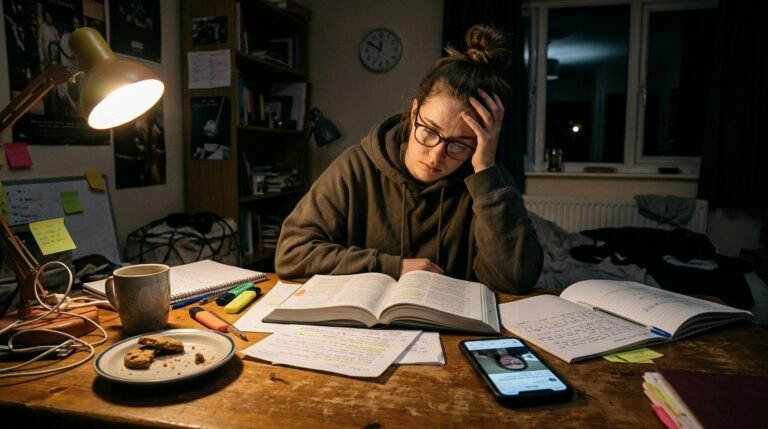
Last night before an exam, you open your book at 10 p.m. and tell yourself you’ll just “go through everything once.” By midnight you’ve covered two pages, eaten four biscuits, and checked your phone about thirty times. Somebody in your class has posted that they’ve finished revision. You close the book, open it again, and feel your chest go tight.
I’m guessing you know that feeling. Pretty much every student does, and the ones who say they don’t are either lying or very lucky.
Exam stress isn’t a character flaw. It’s what happens when something matters to you and the clock is running. A bit of it is actually useful, because it gets you to sit down and start. The trouble comes when it grows so big that you can’t focus, can’t sleep, and can’t remember what you read an hour ago.
So let’s talk about how to keep it at a size you can live with. No magic tricks. Just things that tend to work.
Why you blank out even when you’ve studied
Let’s start with the thing that scares people most. You study for weeks, you walk into the exam hall, and your mind goes white.
This happens because your body can’t tell the difference between a dangerous animal and a difficult paper. Both set off the same alarm. Your heart speeds up, your breathing gets short, and your brain hands its energy to “get out of here” instead of “remember the formula.” Memory takes a back seat.
So a blank moment doesn’t prove you’re unprepared. It means your alarm is ringing too loudly, and alarms can be turned down. Most of what follows is about doing exactly that.
Here’s what too much stress tends to look like, in case you haven’t noticed it creeping up.
| Area | Common signs |
|---|---|
| Body | Headaches, tight shoulders, stomach aches, racing heart, feeling worn out even after sleep |
| Thinking | Can’t concentrate, forgetting things you knew last week, constant “what if” loops |
| Mood | Short temper, crying over small things, feeling flat or hopeless |
| Behaviour | Avoiding your books, eating too much or too little, late nights, ignoring friends |
Recognise a few? That’s fine. It just means it’s time to change something small.
Make the mountain smaller
“Study biology” isn’t a task. It’s a mood. It’s so big and shapeless that your brain would rather scroll through videos than touch it.
“Finish the chapter on the heart and do eight questions” is a task. You know when it’s done.
So grab a pen and your syllabus, and chop it into pieces that take a sitting or two each. Then count the pieces, count the days you have left, and be straight with yourself. If you’ve got fourteen topics and five days, “three topics a day” is not a plan, it’s wishful thinking. Maybe some topics have to be skimmed, or dropped, so decide that now rather than on the last night.
And cross things off visibly. It sounds childish, but watching the list shrink does something a vague sense of “I’m getting there” never will.
Study in short rounds
A lot of us measure studying in hours, like it’s a shift at work. But four hours with your phone buzzing next to you can be worth less than an hour where you really concentrate.
One simple routine: set a timer for 25 minutes and put your phone somewhere you’d have to get up to reach. Work until it rings. Rest for five minutes. After four rounds, take a longer break, around half an hour. If 25 minutes feels too short for you, make it 40. Nobody’s checking.
The five minutes only work if you actually rest. Stretch, drink some water, look out of a window. Scrolling counts as more input, not a rest.
Stop just rereading
I’ll admit this one is hard, because rereading feels so good. The page looks familiar, you nod along, you think “yes, I know this.” Then you close the book, try to write it down, and realise you knew nothing.
Familiar and remembered are different things. The methods that make you dig the answer out of your own head are the ones that stick, and they’re uncomfortable, which is exactly why they work.
| Method | What it looks like | Honest verdict |
|---|---|---|
| Rereading and highlighting | Going over notes again and again | Comfortable, but weak. Fine for a first pass, not for a final one |
| Self-testing | Close the book and write down everything you remember | Shows you your real gaps quickly |
| Past papers | Timed, in exam conditions if you can | Best way to get used to pressure and format |
| Explaining it to someone | A friend, a sibling, even the wall | If you stumble, you’ve found a weak spot |
| Spaced review | Return to a topic after a day, then three days, then a week | Stops you forgetting what you learned on Monday |
You don’t have to do all of these. Pick two. Doing them regularly beats doing five of them once.
Sleep is not optional
There’s a myth that the student who stays up all night is the serious one. In reality, that student often walks into the exam tired, irritable, and unable to think straight.
During sleep your brain sorts and stores what you took in that day. Cut the sleep short and you’re basically throwing away part of your revision. Aim for seven to nine hours, especially in the last week.
Some things that help:
- Go to bed and get up at roughly the same time every day
- Stop studying an hour before bed
- Leave your phone across the room, or at least out of reach
- Skip tea and coffee after the afternoon
- If your mind won’t stop, write your worries or leftover to-dos on paper. It really does help to get them out of your head
Move a bit, even when you “don’t have time“
When exams get close, exercise is the first thing to go. It feels like a waste. But a walk around the block, some stretching, a bit of cricket or football, or a short bike ride burns off stress and wakes you up. You usually return to your desk sharper than you left it.
Think of it this way: if you’re stuck on a problem and getting angrier at it, you’re not really studying anymore. Ten minutes outside often does more for you than another hour of staring.
Eat something real
Exam time often turns into instant noodles, biscuits and cups of tea at all hours. You don’t need a perfect diet, just a bit of care.
| Habit | Why it helps | Easy way to start |
|---|---|---|
| Eat breakfast | Prevents the mid-morning slump | Eggs, oats, paratha with yogurt, fruit and nuts |
| Drink water | Even mild dehydration clouds your focus | A bottle on your desk that you refill |
| Cut back on caffeine | Too much means jitters and bad sleep | Nothing after mid-afternoon |
| Snack on better things | Sugar gives a quick spike then a crash | Dates, bananas, roasted chana, a handful of nuts |
| Keep meal times steady | Steady food, steadier mood | Treat lunch as part of the timetable |
One breathing trick worth learning
When panic rises, the fastest thing you can change is your breathing. Slow breathing tells your body that it’s safe.
Try this. Breathe in through your nose for four counts. Hold for four. Breathe out through your mouth for six. Keep going for a minute or two. The longer breath out is the part that calms you down.
Do it on an ordinary evening a few times, before you actually need it. Then when you’re sitting in the exam hall with your heart pounding, it’ll already feel familiar.
Talk back to the scary stories
Much of exam stress isn’t physical at all. It’s the stories your mind tells you at 2 a.m. “I’m going to fail.” “Everyone’s ahead of me.” “I always mess up.”
When you’re tired and nervous, those feel like facts. They aren’t. They’re fears with good acting skills. Try writing the thought down and then answering it like a sensible friend would.
| The scary thought | A more honest version |
|---|---|
| “I’ll fail and everything will fall apart.” | “I’ve covered a lot. If one paper goes badly, I still have options.” |
| “Everyone else is ahead of me.” | “I only hear what people choose to say. I’ll check my own progress.” |
| “I always freeze.” | “It’s happened before, but now I’ve got a breathing routine and a plan.” |
| “I should have started earlier.” | “True, and I can’t change it. What can I do with the days I’ve got?” |
Notice the right-hand column isn’t fake positivity. You don’t have to believe you’ll be top of the class. You only need a thought that’s true and doesn’t drag you under.
Be careful about comparing
Study groups can be useful, but they can also wreck your mood in two minutes. Someone says they’ve revised the whole book three times, and suddenly you’re certain you’re behind. Yet people exaggerate, they leave out their bad days, and everyone learns differently. Plenty of them are scared too, just quieter about it.
The only comparison worth making is with yourself a week ago. Do you understand more? Have you covered more? If yes, you’re moving. And if a certain group chat leaves you feeling worse every time, mute it until the exams are over. That isn’t rude, it’s self-protection.
Plan the final week, but leave gaps
The days before an exam can turn messy, so a simple routine saves you from making a hundred small decisions. Here’s a rough shape you can bend.
| Time of day | What to do |
|---|---|
| Morning | Get up on time, eat, do the hardest subject while you’re fresh |
| Late morning | Practice questions or self-testing |
| Midday | Proper lunch, short rest, some air |
| Afternoon | Weak topics or a past paper |
| Evening | Light revision, then stop. Be with family, go for a walk |
| Night | Pack your bag and keep your bedtime |
Leave some empty space on purpose. The power cut will happen, or a guest will turn up, or you’ll just wake up feeling flat. A schedule with no slack turns into guilt the moment one thing goes wrong.
The day before the exam, don’t try to learn big new topics. Read your short notes, double-check the time and the venue, pack your pens and your admit card, and sleep early. Future you at 7 a.m. will be grateful.
Know what you’ll do in the exam hall
Panic often comes from not knowing what to do when a question stumps you. So decide before you go in.
| Moment | What to do |
|---|---|
| Paper in front of you | Spend a minute reading the whole thing first |
| Starting | Begin with a question you feel good about to get rolling |
| Time | Divide it by marks, and check the clock now and then |
| Stuck | Mark it, move on, and come back. Your mind often works on it quietly |
| Blank mind | Pen down, a few slow breaths, then write anything related, even rough ideas |
| Finished early | Use the time to check, not to rush out |
| After the paper | Don’t compare answers with friends |
That last one is tough, because everyone wants to know how it went. But post-exam discussions rarely help. You can’t change what’s written, and hearing “oh, I put something totally different” will cost you your focus for the next paper. Agree to talk after the final exam, and go home.
When to ask for help
Normal stress comes and goes. If it starts taking over, that’s different. Consider talking to someone if you haven’t slept properly for several days, you feel hopeless or overwhelmed most of the time, you’re getting panic attacks, you’ve lost interest in things you usually enjoy, or the worry simply won’t switch off.
Tell someone you trust, whether that’s a parent, an older sibling, a friend, a teacher, or a counsellor at your school or college. Lots of institutions offer free counselling, and using it is a sensible move, not a weak one. And if you ever have thoughts of harming yourself, please contact a mental health professional or a crisis helpline where you live straight away. No exam is worth more than you are.
Often, just saying “I’m really stressed” to another person lifts more weight than you’d expect.
What an exam actually is
It’s easy to feel as though a result decides who you are. It doesn’t. An exam shows how well you could put certain knowledge on paper, on one day, in one room, under one kind of pressure. Plenty of people who have done well in life had a bad exam somewhere along the way.
None of this means you shouldn’t care. Caring is what gets you to prepare. Just try to keep your effort and your self-worth in separate boxes. You can work hard and still be kind to yourself if it doesn’t go perfectly.
Quick recap
| Tip | In a line |
|---|---|
| Break up the syllabus | Small tasks feel possible |
| Short study rounds | Focus beats long hours |
| Active study | Test yourself, don’t just reread |
| Sleep | It’s where your brain saves your work |
| Move | Ten minutes can clear your head |
| Eat and drink | Steady energy, steadier nerves |
| Breathing | Long exhales calm your body |
| Question your thoughts | Fears aren’t facts |
| Stop comparing | Measure against last week’s you |
| Routine | Fewer decisions, less stress |
| Exam plan | Know what to do when you’re stuck |
| Ask for help | Saying it out loud lightens it |
Before you go
There’s no single trick that makes exam stress vanish. What helps is a few small habits repeated day after day: a realistic plan, decent sleep, a bit of fresh air, some slow breathing, and a little kindness toward yourself when things get hard.
Please don’t try to do all twelve at once. That turns into one more thing to worry about. Pick two or three that feel easy, maybe a fixed bedtime and a daily walk, and begin tonight. Add the rest when you’re ready.
You’ve probably done more than you give yourself credit for. Trust that, and go write the paper.
