


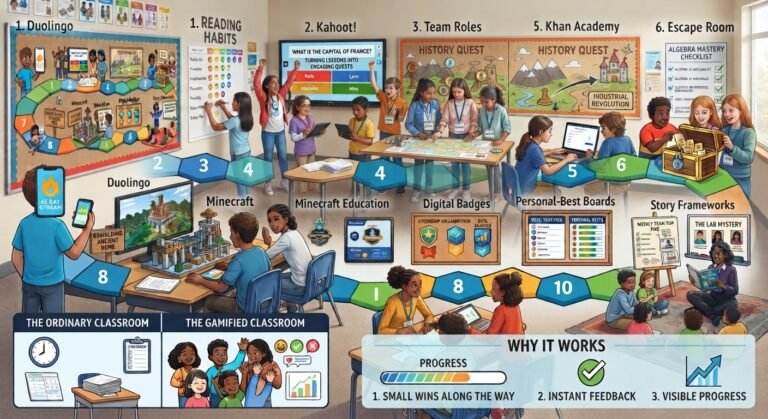
I keep coming back to that moment because it explains why gamification works better than most education trends. It’s not magic. It just changes how a task feels. Same worksheet, same kids, different stakes.
The catch is that most advice on this is either vague (“make it fun!”) or expensive (“buy this platform!”). So this is a list of ten examples that work, what each one gets right, and a cheap way to try it. Some are apps. Several are just paper and a loud teacher.
The Short Version of Gamification Examples
| What changes | Ordinary lesson | Gamified lesson |
|---|---|---|
| Feedback | A grade, someday | Right now |
| Goals | One big exam at the end | Small wins along the way |
| Mistakes | Marked and remembered | Try again, no shame |
| Motivation | Grades and approval | Progress, choice, teammates |
| Progress | Hidden in a gradebook | Out in the open |
| The vibe | Quiet and solo | Shared and a bit noisy |
| # | Example | One-line version | What it builds |
|---|---|---|---|
| 1 | Duolingo streaks | Don’t break the chain | Habit |
| 2 | Kahoot! quizzes | Game-show review | Recall |
| 3 | Team roles | Everyone’s a character | Teamwork |
| 4 | Quest-based courses | Missions, not assignments | Persistence |
| 5 | Khan Academy mastery | Level up skill by skill | Self-paced mastery |
| 6 | Escape rooms | Puzzles hiding the curriculum | Problem-solving |
| 7 | Minecraft Education | Build it, don’t just write it | Creativity |
| 8 | Digital badges | Proof of a real skill | Goal-setting |
| 9 | Team and personal-best boards | Compete without crushing anyone | Growth mindset |
| 10 | Story frameworks | Turn a unit into a mystery | Critical thinking |
What Gamification Actually Means
It means borrowing what keeps people going in games, like points, clear goals, instant feedback, and visible progress, and using it on something that isn’t a game. A normal lesson. A homework routine. A training course.
Game-based learning is the cousin. There, the game itself is the lesson. Twenty minutes of a math game is game-based learning. Earning a badge for finishing regular math practice is gamification. Plenty of good teaching blends both, so don’t stress about the line.
| Game element | What it does | In a classroom |
|---|---|---|
| Points | Instant feedback on effort | 10 points per practice set |
| Badges | Marks a specific win | “Citation Master” for a clean bibliography |
| Levels | Shows growth | Apprentice to Expert over a unit |
| Leaderboards | Friendly rivalry | Weekly top five on quizzes |
| Quests | Gives work a story | “Save the village” using ratios |
| Streaks | Builds a habit | Seven days of reading in a row |
| Avatars | Makes it personal | Customizing a character as you learn |
The game is never the point. If students are chasing points and learning nothing, you’ve built an expensive distraction.
Why It Works
People don’t dodge learning because they’re lazy. They dodge it when it feels pointless, slow, or embarrassing. Games fix all three.
Feedback arrives in seconds, not next Thursday. Scary goals get cut into small wins. And failing is cheap. Lose a round of a quiz game and you laugh and go again. Bomb a test and it sits on your record. Same mistake, very different price.
Researchers describe this through self-determination theory: people stay motivated when they have some choice, when they feel themselves improving, and when they feel connected to others. It’s a handy checklist. Does the activity give students a say? Can they see themselves getting better? Is someone alongside them?
The Ten Examples
1. Duolingo
You earn XP, keep a daily streak, and compete in a weekly league with strangers. The streak is the clever, slightly evil part. Around day 60, you will open the app at 11 p.m. half asleep just to protect it. Each lesson takes about three minutes, so starting never feels like a big deal.
Try it: Copy the habit, not the app. Pick one tiny daily thing, like five minutes of silent reading, and put a chart on the wall.
2. Kahoot!
Students join on their phones, race through timed questions, and watch the leaderboard reshuffle every round. Half the engagement is the music and the groaning when someone loses by half a second. Prep is minimal: ten minutes to build a quiz, or borrow one from the public library.
Try it: Open class with it, on yesterday’s material. Pulling information out of your head is one of the best-supported ways to remember it. Show only the top five, so nobody’s last place gets projected twelve feet wide.
3. Team Roles (the Classcraft idea)
Classcraft turned classes into fantasy adventures, with warriors, mages, and healers earning points for good work. Check whether it’s still running before you build anything around it, since products like this come and go. The software was never the interesting part anyway.
The interesting part is what a role does to a kid. Give a quiet student the job of “healer,” the person who checks that teammates aren’t stuck, and sometimes they step into it in a way “Group 3, Member 2” never allowed.
Try it: For free. Hand out roles like captain, scribe, skeptic, and presenter, and rotate them weekly.
4. Quest-Based Courses
A few teachers rebuild a whole course as a quest. Assignments become missions. Students start at zero and climb instead of starting at 100 and watching it shrink. A history class turns into a journey through the centuries, with each era unlocked by clearing a challenge.
It reframes failure. A low score stops meaning “you lost” and starts meaning “not done yet.”
Try it: Nobody can rebuild a course on a Sunday night, so steal one piece: let students redo work after feedback and keep the better grade. More grading, yes. Also the fastest way I know to keep kids trying.
5. Khan Academy’s Mastery Levels
Skills move through attempted, familiar, proficient, and mastered, with points and badges sprinkled along the way. The real value is clarity. A learner sees exactly what they’ve nailed and what’s still wobbly, instead of a mystery “74%.”
Try it: A paper checklist of the skills in your unit, colored in as students master each one. It takes ten minutes and works better than it should.
6. Escape Rooms
Students solve a chain of puzzles to open a locked box. Each puzzle is a curriculum question wearing a costume: decode a cipher with a chemistry formula, solve equations to find a lock combination, hunt for clues in a short story. Because the puzzles link together, nobody gets to coast.
Try it: Three puzzles, each using a different skill, finishing with a cheap number lock. Run it as exam review.
7. Minecraft: Education Edition
Strictly speaking, this is game-based learning rather than gamification, but it earns its place. Students rebuild ancient Rome, model ecosystems, or practice coding, making things the whole time instead of reading about them.
Try it: No software? Offer “build it” options. A model, a map, or a giant hand-drawn diagram can show understanding as well as a five-paragraph report, and sometimes better for kids who freeze at a blank page.
8. Digital Badges
Badges get mocked because people hand them out like Halloween candy. A badge for showing up is worthless. A badge tied to a real skill with a clear standard, like data analysis or lab safety, makes an invisible skill visible and tells the learner what to chase next.
Try it: Three to five badges, each tied to something you could point at. If you can’t explain exactly what earns it, it’s decoration.
9. Team Boards and Personal Bests
If the same three students top the leaderboard every week, everyone else works out fast that there’s no point trying. Fix it by changing what you rank. Team boards share the pressure. “Personal best” boards compare you only to your own earlier scores, the one fair competition there is. Many British and international schools run house-point systems for this reason.
Try it: Track improvement, not just raw scores. The kid who went from 55% to 75% deserves a cheer as loud as the one who scored 95%.
10. Stories
Sometimes the strongest game element is a story. Start a science unit with “Someone has contaminated the town’s water, and your team of detectives has to find out who.” Every lab becomes a clue. People remember stories far better than loose facts.
Try it: A problem, a goal, a twist or two. That’s all.
Which One Should You Start With?
| Example | Best for | Setup effort | Tech needed | Main motivator |
|---|---|---|---|---|
| Duolingo-style streaks | Habits, languages | Low | Optional | Consistency |
| Kahoot! quizzes | Review | Low | Devices | Friendly rivalry |
| Team roles | Group work | Medium | Optional | Teamwork |
| Quest-based courses | Full course redesign | High | Optional | Autonomy |
| Khan Academy mastery | Self-paced practice | Low | Yes | Competence |
| Escape rooms | Exam review | Medium | No | Curiosity |
| Minecraft Education | Creative projects | High | Yes | Creativity |
| Digital badges | Recognizing skills | Medium | Yes | Achievement |
| Team boards | Community | Low | Optional | Belonging |
| Story frameworks | Any subject or age | Medium | No | Curiosity |
My pick for a first try is a streak chart or a quick quiz. Cheap, fast, hard to wreck.
Starting Without Losing Your Mind
Don’t overhaul everything this weekend. Start with what you want students to be able to do, then pick one game element that supports it. Change one thing at a time and give it two weeks. Keep feedback quick. Give students a little choice. And ask them, because they know instantly what feels fun and what feels forced.
| Week | What to do | What to watch for |
|---|---|---|
| 1 | Launch a simple streak or points system | Do they get the rules? |
| 2 | Add a weekly team challenge | Are the quiet kids joining in? |
| 3 | Introduce one meaningful badge | Real effort, or point-chasing? |
| 4 | Ask for feedback and adjust | What stays, changes, goes? |
Where It Goes Wrong
| Mistake | Why it hurts | Try this instead |
|---|---|---|
| Rewarding everything | Points stop meaning anything | Reward effort, progress, mastery |
| Only public rankings | Low scorers check out | Teams, personal bests, top-five views |
| Forgetting the learning goal | Kids chase points, not understanding | Tie every mechanic to a skill |
| Overcomplicated rules | More time decoding than learning | If it takes over a minute to explain, cut it |
| Using it as punishment | Fear replaces motivation | Stick to positive recognition |
Some students flat-out hate competing, and that’s fine. Give them another way in, like shared goals or tracking their own progress.
Quick Answers
Does it work on adults? Yes. Corporate training and university courses use badges, simulations, and leaderboards constantly. Skip the cartoon look and tie it to real stakes.
Is it the same as game-based learning? Not quite. One adds game features to ordinary activities, the other uses a real game as the lesson.
Do I need expensive software? No. Paper charts, rotating roles, and free tools go a long way.
Can rewards kill real motivation? They can, if the reward becomes the only reason anyone shows up. Keep the focus on mastery, choice, and purpose.
How will I know it’s working? Look at participation, completion, quiz results over time, and what students tell you, compared with a similar stretch before you changed anything.
Where I’d Land
Gamification isn’t about making school silly. It’s about how people actually stay motivated: clear goals, fast feedback, visible progress, and the sense that effort leads somewhere.
Pick one idea, try it for two weeks, and watch what happens to the room.
